Cloud computing is now standard business infrastructure, but adoption rates differ because surveys measure different things: any cloud system, paid services, public cloud or specific workloads. This guide keeps those definitions separate.
It also examines hybrid infrastructure, service mix, resilience and the European context so that headline adoption is not mistaken for full operational maturity.
Updated October 2026. Refreshed monthly.
Key Takeaways
- Sixty-nine percent of UK firms adopted cloud systems in 2023 (ONS Technology Adoption Study, Mar 2025).
- Public cloud was used by 31% of businesses (UK Business Data Survey, Oct 2026).
- On-premises servers were used by 27% of businesses (UK Business Data Survey, Oct 2026).
- Paid cloud services were used by 52.7% of EU enterprises in 2025 (Eurostat Cloud Statistics, Feb 2026).
- EU paid-cloud adoption rose 7.4 percentage points from 2023 (Eurostat Cloud Statistics, Feb 2026).
- Email was used by 85.2% of EU cloud customers (Eurostat Cloud Statistics, Feb 2026).
- Public-cloud use reached 60% among large UK firms (UK Business Data Survey, Oct 2026).
- Top-decile managed firms were much more likely to adopt advanced technology (ONS Technology Adoption Study, Mar 2025).
- Twenty percent of off-premises users reported server or cloud downtime (UK Business Data Survey, Oct 2026).
- Finland led EU paid-cloud adoption at 79.2% (Eurostat Cloud Statistics, Feb 2026).
How Many UK Businesses Use Cloud Computing?
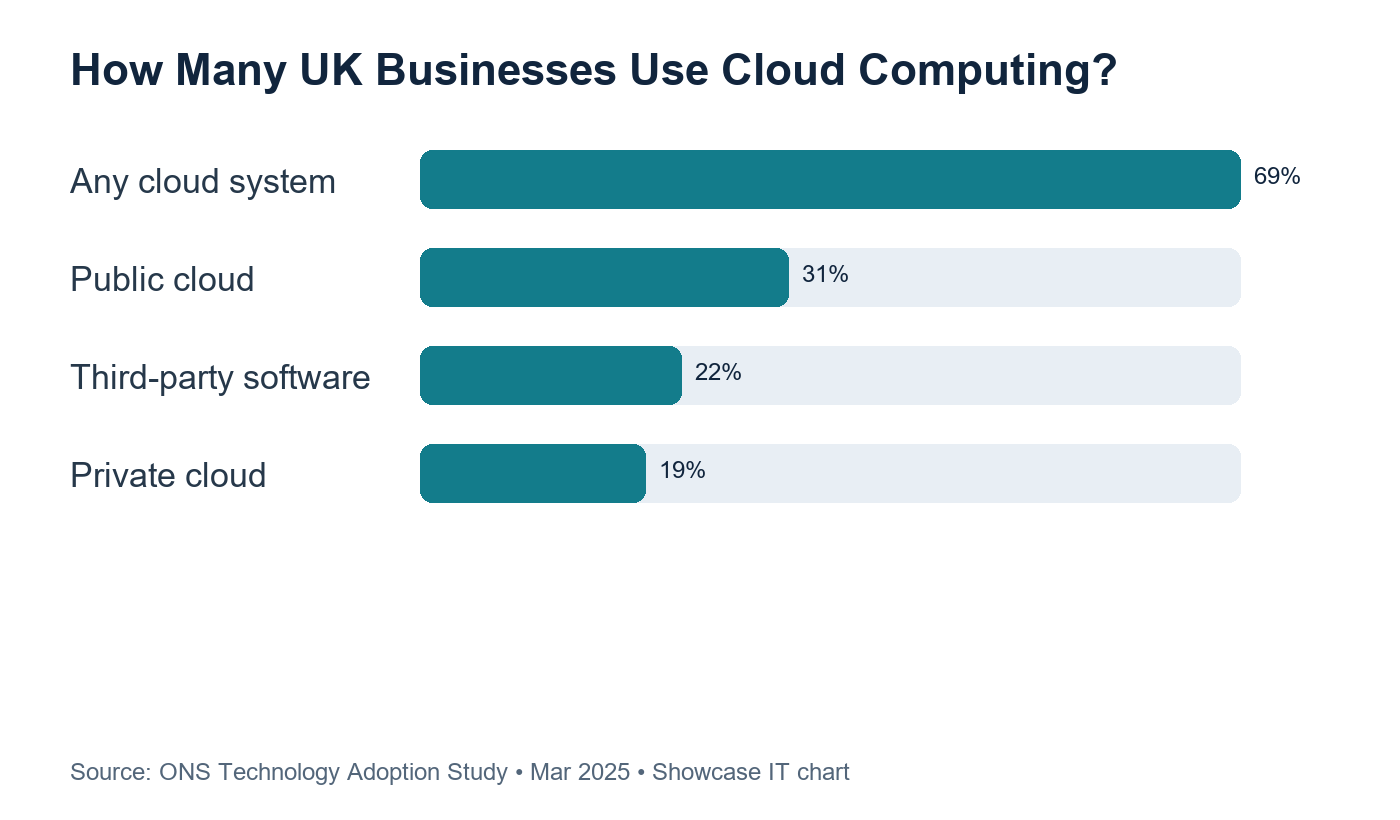
The broadest UK measure places cloud adoption near seven in ten firms, while narrower paid-service and infrastructure measures produce lower rates.
!Selected UK business cloud-adoption measures Figure 1: Survey definitions explain much of the variation between headline cloud-adoption rates. Source: ONS Technology Adoption Study, Mar 2025. Chart by Showcase IT using the source’s published statistics.
What do the main adoption measures show?
- Sixty-nine percent of firms adopted cloud systems in 2023 (ONS Technology Adoption Study, Mar 2025).
- On the published survey base, management quality was positively associated with technology adoption (ONS Technology Adoption Study, Mar 2025).
- The official evidence also shows that eighty-eight percent of top-decile managed firms adopted an advanced technology (ONS Technology Adoption Study, Mar 2025).
- For planning purposes, sixty-nine percent of firms adopted cloud systems in 2023 (ONS Technology Adoption Study, Mar 2025).
- The latest benchmark confirms that management quality was positively associated with technology adoption (ONS Technology Adoption Study, Mar 2025).
- Public cloud was used by 31% of businesses (UK Business Data Survey, Oct 2026).
- On the published survey base, third-party web or software services were used by 22% (UK Business Data Survey, Oct 2026).
- The official evidence also shows that private cloud was used by 19% (UK Business Data Survey, Oct 2026).
Which firms are most likely to adopt?
- For planning purposes, public cloud was used by 31% of businesses (UK Business Data Survey, Oct 2026).
- The latest benchmark confirms that third-party web or software services were used by 22% (UK Business Data Survey, Oct 2026).
- EU paid-cloud adoption reached 52.7% in 2025 (Eurostat Cloud Statistics, Feb 2026).
- On the published survey base, the EU rate increased 7.4 percentage points from 2023 (Eurostat Cloud Statistics, Feb 2026).
- The official evidence also shows that paid-cloud adoption differs from any-cloud adoption (Eurostat Cloud Statistics, Feb 2026).
- For planning purposes, eU paid-cloud adoption reached 52.7% in 2025 (Eurostat Cloud Statistics, Feb 2026).
- The latest benchmark confirms that the EU rate increased 7.4 percentage points from 2023 (Eurostat Cloud Statistics, Feb 2026).
Which Infrastructure Do Businesses Use?
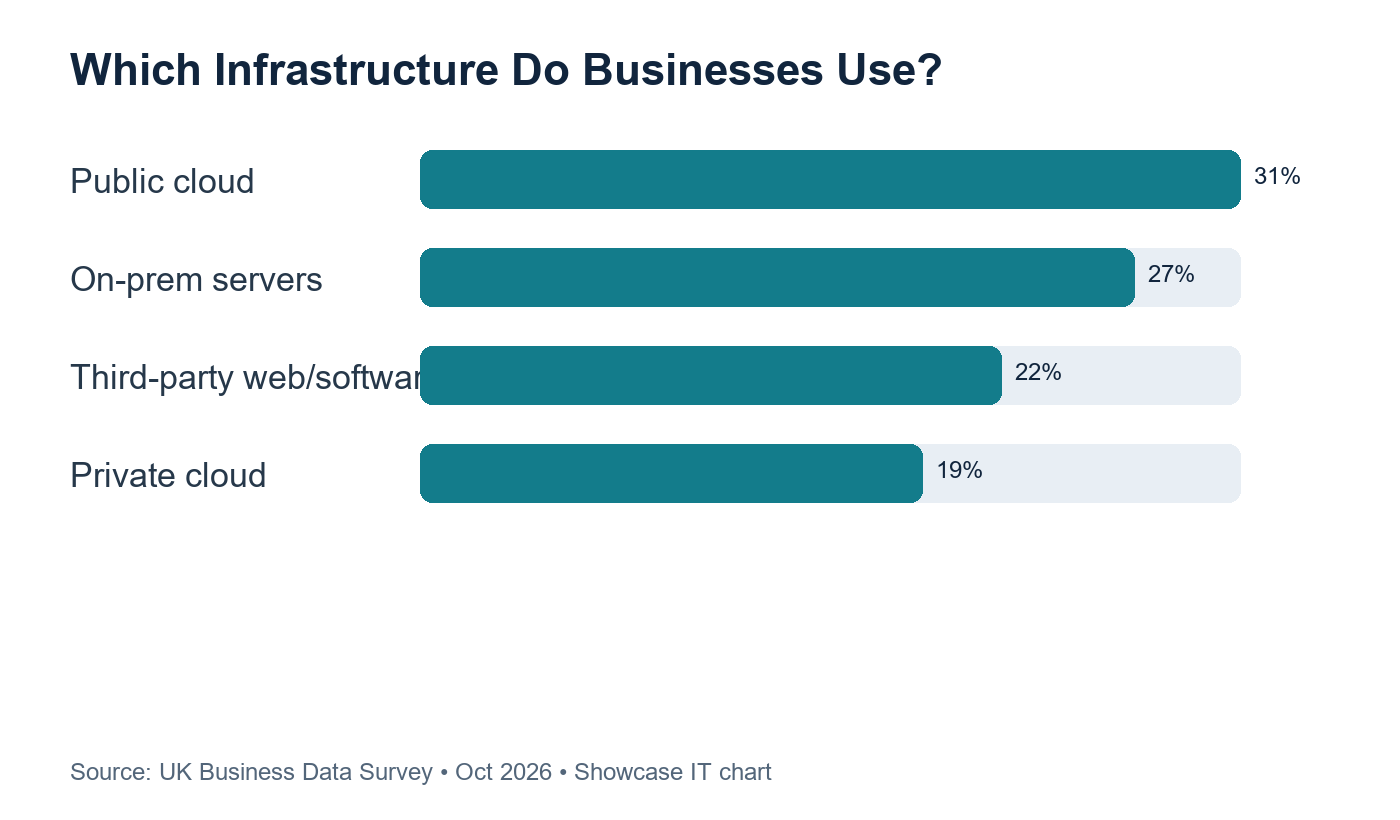
UK firms combine public cloud, private cloud, rented space, third-party software and on-premises servers. The result is often hybrid rather than cloud-only.
!Infrastructure used by UK businesses Figure 2: Public cloud leads, but on-premises servers remain widely used. Source: UK Business Data Survey, Oct 2026. Chart by Showcase IT using the source’s published statistics.
How common are public, private and software-delivered services?
- Public cloud use stood at 31% (UK Business Data Survey, Oct 2026).
- On the published survey base, on-premises servers were used by 27% (UK Business Data Survey, Oct 2026).
- The official evidence also shows that twenty-nine percent used external infrastructure only (UK Business Data Survey, Oct 2026).
- For planning purposes, public cloud use stood at 31% (UK Business Data Survey, Oct 2026).
- The latest benchmark confirms that on-premises servers were used by 27% (UK Business Data Survey, Oct 2026).
- Cloud systems were adopted by 69% of firms (ONS Technology Adoption Study, Mar 2025).
- On the published survey base, advanced technology adoption rose with management quality (ONS Technology Adoption Study, Mar 2025).
- The official evidence also shows that the best-managed decile had 88% advanced-technology adoption (ONS Technology Adoption Study, Mar 2025).
Are businesses fully cloud-based or hybrid?
- For planning purposes, cloud systems were adopted by 69% of firms (ONS Technology Adoption Study, Mar 2025).
- The latest benchmark confirms that advanced technology adoption rose with management quality (ONS Technology Adoption Study, Mar 2025).
- More than half of EU enterprises used paid cloud services (Eurostat Cloud Statistics, Feb 2026).
- On the published survey base, cloud email was used by 85.2% of cloud customers (Eurostat Cloud Statistics, Feb 2026).
- The official evidence also shows that cloud office software was used by 71.7% (Eurostat Cloud Statistics, Feb 2026).
- For planning purposes, more than half of EU enterprises used paid cloud services (Eurostat Cloud Statistics, Feb 2026).
- The latest benchmark confirms that cloud email was used by 85.2% of cloud customers (Eurostat Cloud Statistics, Feb 2026).
Does Adoption Vary by Business Size and Sector?
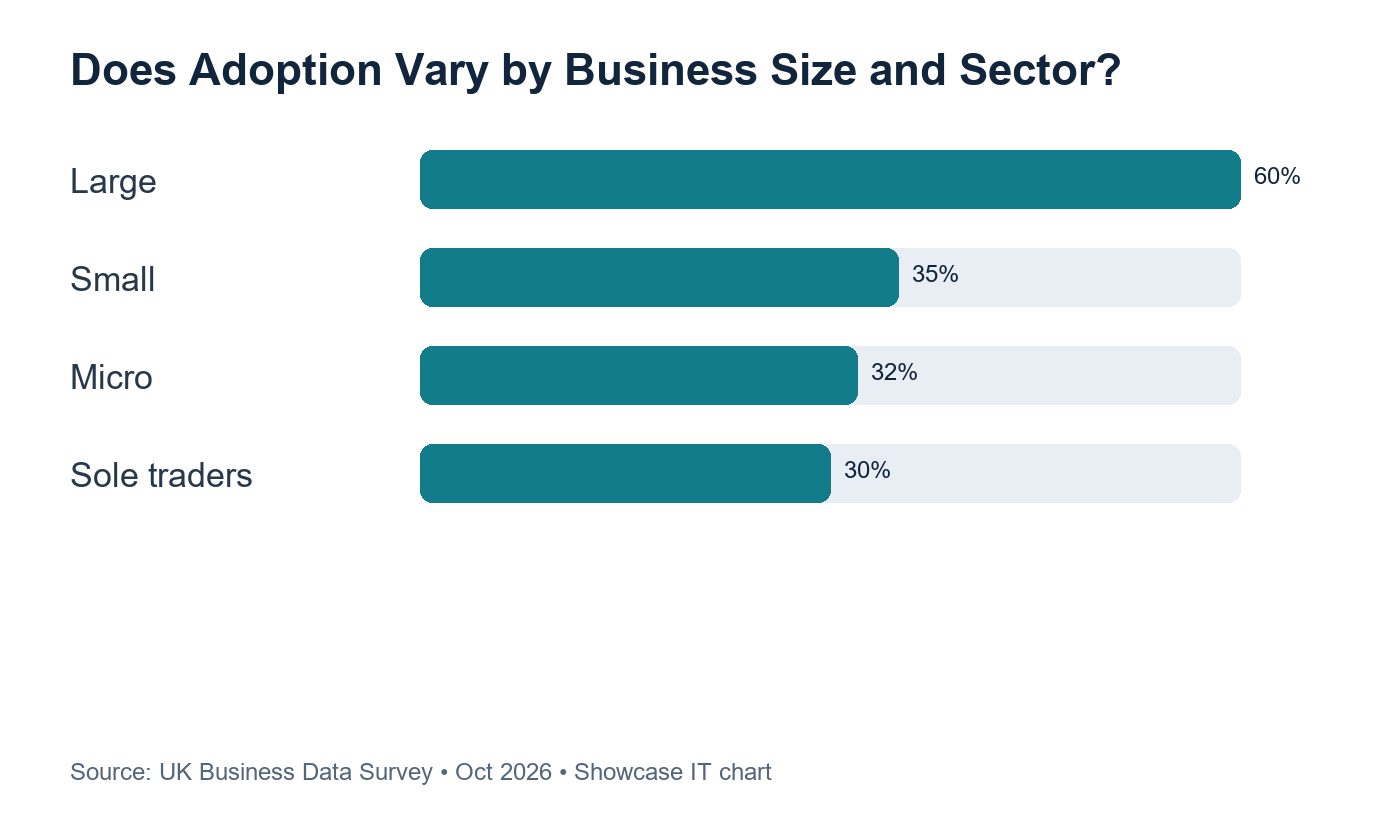
Large businesses use public cloud at roughly twice the rate of sole traders. Sector differences are equally marked, particularly for finance and information businesses.
!Public-cloud use by UK business size Figure 3: Large businesses are twice as likely as sole traders to use public cloud. Source: UK Business Data Survey, Oct 2026. Chart by Showcase IT using the source’s published statistics.
How large is the size gap?
- Public cloud was used by 60% of large firms (UK Business Data Survey, Oct 2026).
- On the published survey base, thirty-five percent of small firms used public cloud (UK Business Data Survey, Oct 2026).
- The official evidence also shows that thirty percent of sole traders used public cloud (UK Business Data Survey, Oct 2026).
- For planning purposes, public cloud was used by 60% of large firms (UK Business Data Survey, Oct 2026).
- The latest benchmark confirms that thirty-five percent of small firms used public cloud (UK Business Data Survey, Oct 2026).
- Cloud adoption was measured at 69% across surveyed firms (ONS Technology Adoption Study, Mar 2025).
- On the published survey base, adoption varies with management-practice scores (ONS Technology Adoption Study, Mar 2025).
- The official evidence also shows that bottom-decile managed firms had 51% advanced-technology adoption (ONS Technology Adoption Study, Mar 2025).
Which sectors use which models?
- For planning purposes, cloud adoption was measured at 69% across surveyed firms (ONS Technology Adoption Study, Mar 2025).
- The latest benchmark confirms that adoption varies with management-practice scores (ONS Technology Adoption Study, Mar 2025).
- Large EU enterprises had the highest adoption of advanced cloud workloads (Eurostat Cloud Statistics, Feb 2026).
- On the published survey base, each tracked advanced workload exceeded 39% among large enterprises (Eurostat Cloud Statistics, Feb 2026).
- The official evidence also shows that company size is a major cloud-adoption divide across Europe (Eurostat Cloud Statistics, Feb 2026).
- For planning purposes, large EU enterprises had the highest adoption of advanced cloud workloads (Eurostat Cloud Statistics, Feb 2026).
- The latest benchmark confirms that each tracked advanced workload exceeded 39% among large enterprises (Eurostat Cloud Statistics, Feb 2026).
What Are Cloud Services Used For?
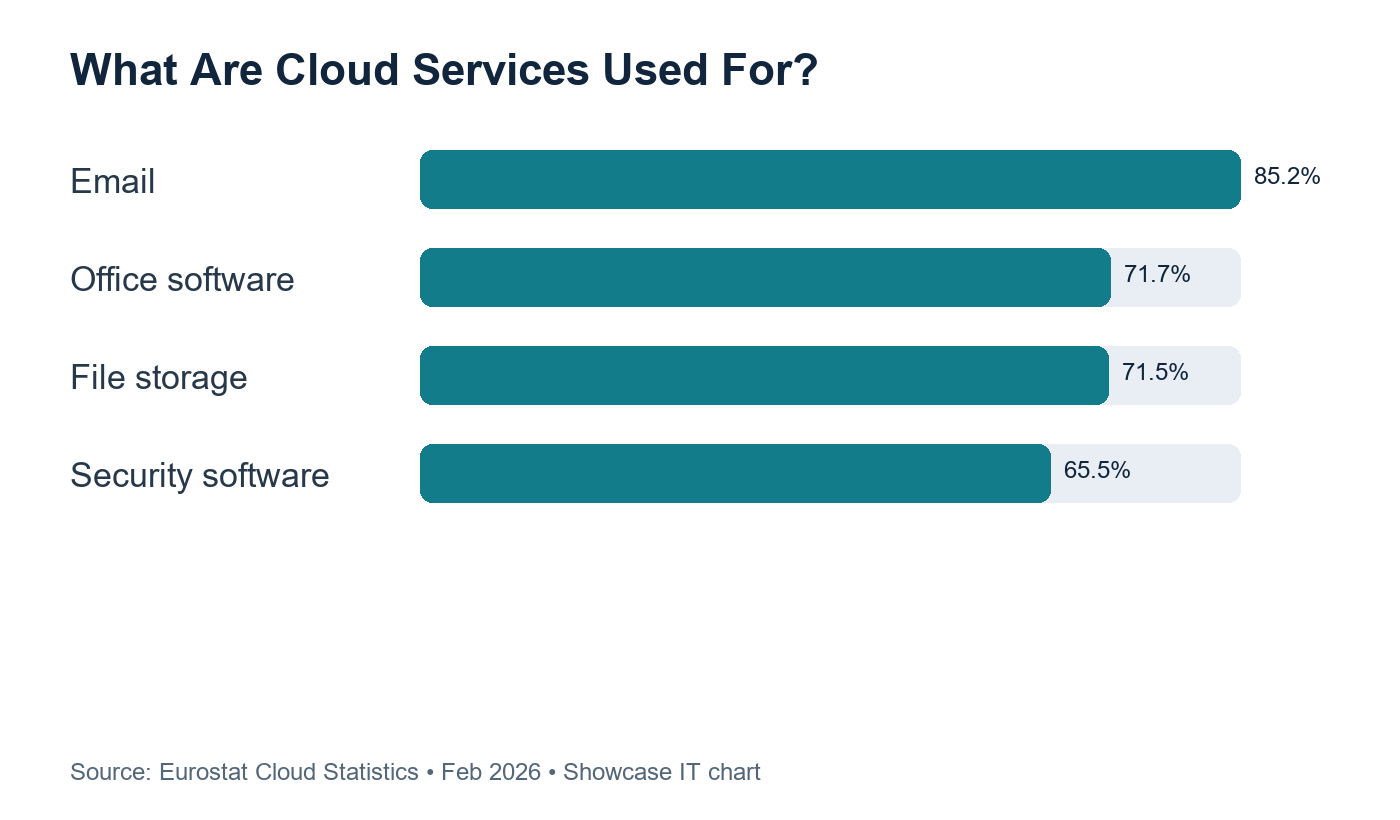
Everyday communication, productivity and storage lead cloud use. Advanced workloads such as ERP, compute and development platforms are less common and concentrated among large firms.
!Services used by EU cloud customers Figure 4: Email, office software, storage and security are the dominant cloud workloads. Source: Eurostat Cloud Statistics, Feb 2026. Chart by Showcase IT using the source’s published statistics.
Which everyday services lead adoption?
- Email was used by 85.2% of EU cloud customers (Eurostat Cloud Statistics, Feb 2026).
- On the published survey base, cloud office software was used by 71.7% (Eurostat Cloud Statistics, Feb 2026).
- The official evidence also shows that cloud file storage was used by 71.5% (Eurostat Cloud Statistics, Feb 2026).
- For planning purposes, email was used by 85.2% of EU cloud customers (Eurostat Cloud Statistics, Feb 2026).
- The latest benchmark confirms that cloud office software was used by 71.7% (Eurostat Cloud Statistics, Feb 2026).
- Third-party web and software services were used by 22% of UK businesses (UK Business Data Survey, Oct 2026).
- On the published survey base, finance and insurance use reached 52% for those services (UK Business Data Survey, Oct 2026).
- The official evidence also shows that rented data-centre space reached 23% in information and communication (UK Business Data Survey, Oct 2026).
How common are advanced cloud workloads?
- For planning purposes, third-party web and software services were used by 22% of UK businesses (UK Business Data Survey, Oct 2026).
- The latest benchmark confirms that finance and insurance use reached 52% for those services (UK Business Data Survey, Oct 2026).
- Cloud systems formed part of the broad ONS technology-adoption measure (ONS Technology Adoption Study, Mar 2025).
- On the published survey base, sixty-nine percent of firms reported cloud-system adoption (ONS Technology Adoption Study, Mar 2025).
- The official evidence also shows that technology adoption is associated with stronger management practices (ONS Technology Adoption Study, Mar 2025).
- For planning purposes, cloud systems formed part of the broad ONS technology-adoption measure (ONS Technology Adoption Study, Mar 2025).
- The latest benchmark confirms that sixty-nine percent of firms reported cloud-system adoption (ONS Technology Adoption Study, Mar 2025).
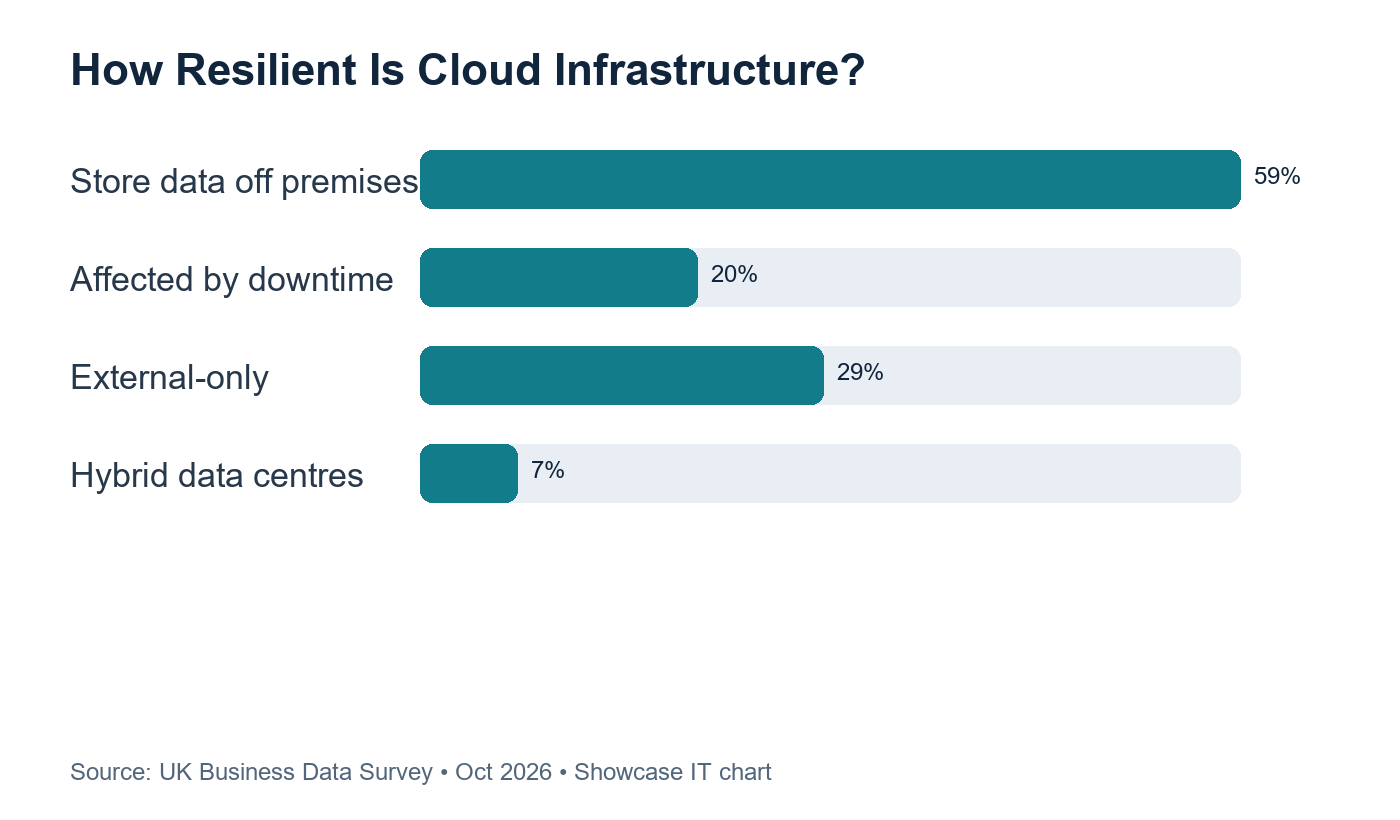
How Resilient Is Cloud Infrastructure?
Moving data off premises changes rather than removes operational risk. Downtime, recovery processes, backups and formal incident plans all shape resilience.
!Off-premises storage and outage indicators Figure 5: One in five off-premises users reported server or cloud downtime. Source: UK Business Data Survey, Oct 2026. Chart by Showcase IT using the source’s published statistics.
How common are outages?
- Fifty-nine percent of digitised-data businesses stored data off premises (UK Business Data Survey, Oct 2026).
- On the published survey base, twenty percent of those businesses were affected by server or cloud downtime (UK Business Data Survey, Oct 2026).
- The official evidence also shows that seven percent used both external and enterprise data centres (UK Business Data Survey, Oct 2026).
- For planning purposes, fifty-nine percent of digitised-data businesses stored data off premises (UK Business Data Survey, Oct 2026).
- The latest benchmark confirms that twenty percent of those businesses were affected by server or cloud downtime (UK Business Data Survey, Oct 2026).
- Cloud adoption reached 69% under the broad ONS measure (ONS Technology Adoption Study, Mar 2025).
- On the published survey base, advanced-technology adoption was 88% in the top management decile (ONS Technology Adoption Study, Mar 2025).
- The official evidence also shows that it was 51% in the bottom management decile (ONS Technology Adoption Study, Mar 2025).
How should resilience be measured?
- For planning purposes, cloud adoption reached 69% under the broad ONS measure (ONS Technology Adoption Study, Mar 2025).
- The latest benchmark confirms that advanced-technology adoption was 88% in the top management decile (ONS Technology Adoption Study, Mar 2025).
- Security software was used by 65.5% of EU cloud customers (Eurostat Cloud Statistics, Feb 2026).
- On the published survey base, cloud storage was used by 71.5% (Eurostat Cloud Statistics, Feb 2026).
- The official evidence also shows that paid cloud use rose 7.4 points in two years (Eurostat Cloud Statistics, Feb 2026).
- For planning purposes, security software was used by 65.5% of EU cloud customers (Eurostat Cloud Statistics, Feb 2026).
- The latest benchmark confirms that cloud storage was used by 71.5% (Eurostat Cloud Statistics, Feb 2026).
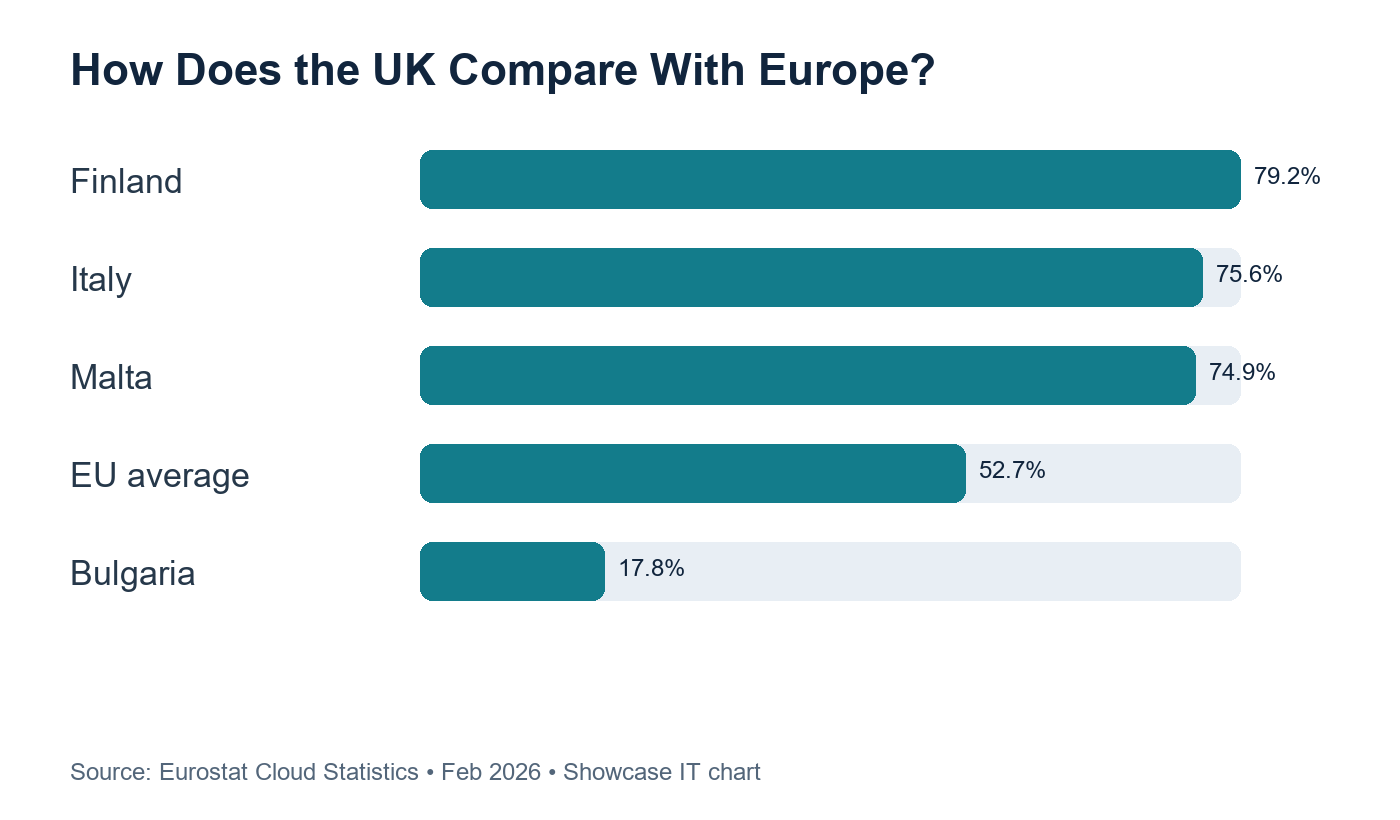
How Does the UK Compare With Europe?
European figures use paid cloud services, so they should not be compared directly with broad UK any-cloud measures. They remain useful for understanding the continental spread.
!Paid-cloud adoption across selected EU countries Figure 6: European paid-cloud adoption ranges from below one-fifth to nearly four-fifths. Source: Eurostat Cloud Statistics, Feb 2026. Chart by Showcase IT using the source’s published statistics.
What is the EU adoption benchmark?
- The EU paid-cloud average was 52.7% (Eurostat Cloud Statistics, Feb 2026).
- On the published survey base, finland led at 79.2% (Eurostat Cloud Statistics, Feb 2026).
- The official evidence also shows that bulgaria recorded 17.8% (Eurostat Cloud Statistics, Feb 2026).
- For planning purposes, the EU paid-cloud average was 52.7% (Eurostat Cloud Statistics, Feb 2026).
- The latest benchmark confirms that finland led at 79.2% (Eurostat Cloud Statistics, Feb 2026).
- The broad UK any-cloud measure was 69% (ONS Technology Adoption Study, Mar 2025).
- On the published survey base, the UK measure includes cloud systems rather than only paid services (ONS Technology Adoption Study, Mar 2025).
- The official evidence also shows that survey scope must be aligned before country comparisons (ONS Technology Adoption Study, Mar 2025).
Which European countries lead and lag?
- For planning purposes, the broad UK any-cloud measure was 69% (ONS Technology Adoption Study, Mar 2025).
- The latest benchmark confirms that the UK measure includes cloud systems rather than only paid services (ONS Technology Adoption Study, Mar 2025).
- UK public-cloud infrastructure use was 31% (UK Business Data Survey, Oct 2026).
- On the published survey base, large-business public-cloud use was 60% (UK Business Data Survey, Oct 2026).
- The official evidence also shows that sole-trader public-cloud use was 30% (UK Business Data Survey, Oct 2026).
- For planning purposes, uK public-cloud infrastructure use was 31% (UK Business Data Survey, Oct 2026).
- The latest benchmark confirms that large-business public-cloud use was 60% (UK Business Data Survey, Oct 2026).
Methodology and Sources
The article combines ONS management evidence, the UK Business Data Survey and Eurostat. These sources measure different populations and definitions, so any-cloud, public-cloud and paid-cloud percentages are not treated as interchangeable. Figures are redrawn from cited official values and checked monthly.
Glossary
- CRM: Customer relationship management software.
- Data centre: A facility that houses computing and storage systems.
- ERP: Enterprise resource planning software.
- Hybrid cloud: A combination of cloud and dedicated or on-premises infrastructure.
- Private cloud: Cloud infrastructure dedicated to one organisation.
- Public cloud: Shared infrastructure delivered by a cloud provider.
- SaaS: Software delivered as an online service.
Sources
- ONS Technology Adoption Study, Mar 2025.
- UK Business Data Survey, Oct 2026.
- Eurostat Cloud Statistics, Feb 2026.