The UK technology sector is not a niche corner of the economy. It combines more than one hundred thousand companies with above-average productivity, pay and long-term demand for specialist workers.
This evidence hub uses the newest official releases available in October 2026. The figures distinguish the government’s Digital and Technologies sector definition from the narrower Digital Sector employment series, because treating those measures as interchangeable would produce false comparisons.
Updated October 2026. Refreshed monthly.
Key Takeaways
- The official Digital and Technologies definition contains 107,082 UK companies (DSIT Economic Statistics, Jun 2026).
- The narrower Digital Sector supported approximately 1.81 million filled jobs in 2025 (Digital Employment Estimates, Oct 2026).
- Skills England expects total expansion and replacement demand of about 488,000 workers across priority digital and technology occupations by 2035 (Skills England, Aug 2026).
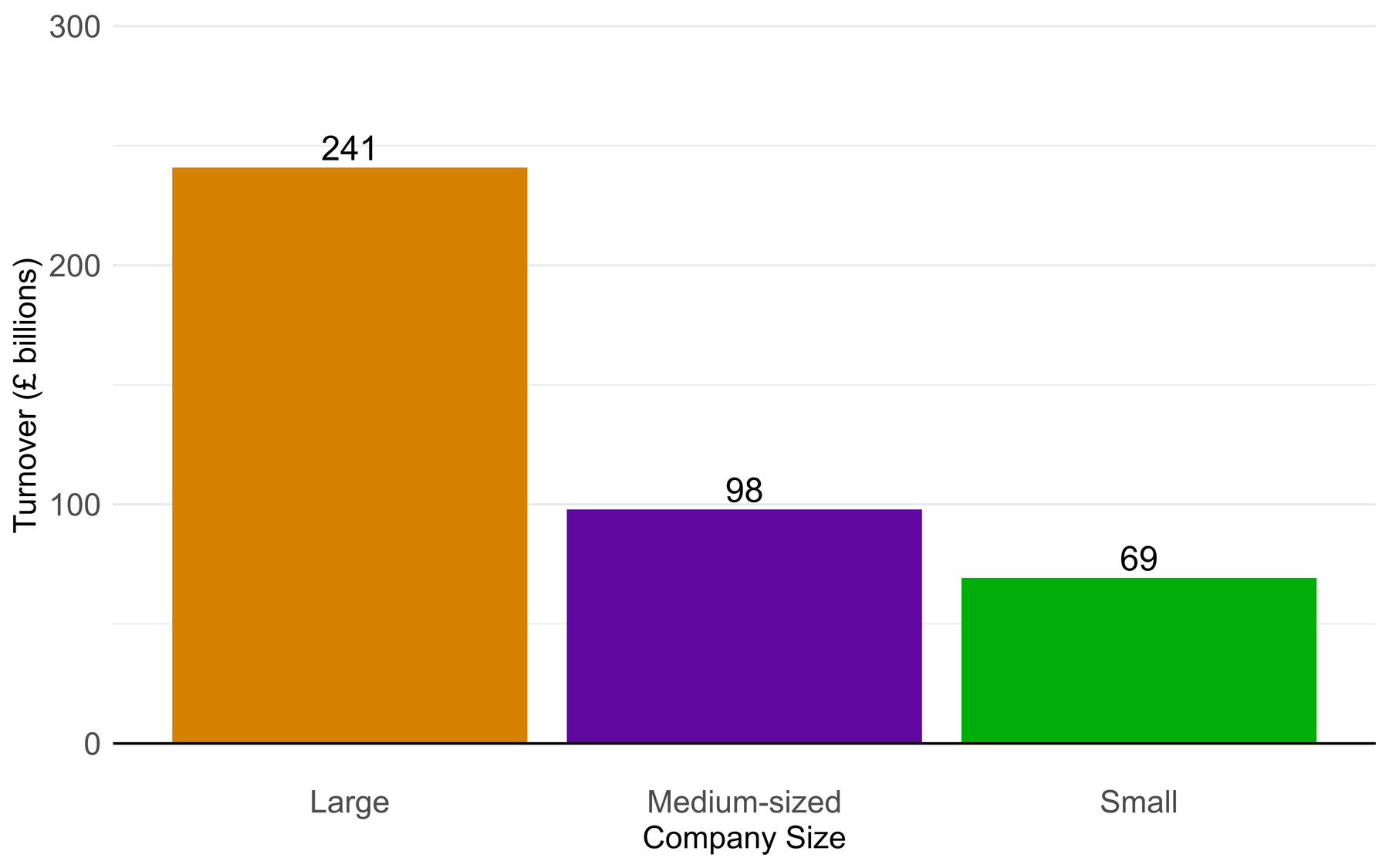
- Digital and Technologies companies generated an estimated £408 billion in 2024 turnover (DSIT Economic Statistics, Jun 2026).
- Digital-sector employment grew 2.1% in 2025 while total UK employment grew 1.1% (Digital Employment Estimates, Oct 2026).
- Eighty-nine percent of projected additional employment in priority occupations requires qualifications at Level 4 or above (Skills England, Aug 2026).
- Sector productivity averaged £119,000 in GVA per employee (DSIT Economic Statistics, Jun 2026).
- Women held 29.9% of Digital Sector filled jobs in 2025 (Digital Employment Estimates, Oct 2026).
- Sixty-eight percent of priority digital and technology occupations are in critical or elevated demand (Skills England, Aug 2026).
- The estimated average sector wage was £56,000 (DSIT Economic Statistics, Jun 2026).
- London and the South East together held 44.3% of Digital Sector employment (Digital Employment Estimates, Oct 2026).
- Programmers and software developers may require 69,000 additional sector workers by 2035 (Skills England, Aug 2026).
How Large Is the UK Digital and Technology Sector?
Scale depends on the definition used. The broad company-based measure shows an industry with substantial national reach, while employment and skills datasets reveal how much activity sits beyond conventional software firms.
!UK digital and technology sector turnover by company size in 2024 Figure 1: Large companies generated most sector turnover, even though small companies dominated the business count. Source: DSIT Economic Statistics, Jun 2026. Official chart published by the source, captured 5 Oct 2026.
How many companies and workers are included?
- Digital and Technologies companies represented 5.2% of all companies in the UK (DSIT Economic Statistics, Jun 2026).
- The broad sector employed an estimated 1.33 million people inside companies in 2024 (DSIT Economic Statistics, Jun 2026).
- That company-based employment estimate equalled 5.8% of UK company employment (DSIT Economic Statistics, Jun 2026).
- The Digital Sector employment series measured 1.77 million filled jobs in 2024 (Digital Employment Estimates, Oct 2026).
- The same series measured 1.89 million filled jobs in 2023 (Digital Employment Estimates, Oct 2026).
- Skills England uses a wider policy definition that includes digital, AI, cybersecurity, quantum, semiconductors, advanced connectivity and engineering biology (Skills England, Aug 2026).
- The skills assessment identified 30 priority occupations for the sector (Skills England, Aug 2026).
How much commercial activity does the sector generate?
- Sector turnover represented about 8.2% of total turnover generated by UK companies (DSIT Economic Statistics, Jun 2026).
- Frontier-technology companies generated an estimated £237 billion in turnover (DSIT Economic Statistics, Jun 2026).
- Frontier technologies therefore accounted for 58.0% of broad-sector turnover (DSIT Economic Statistics, Jun 2026).
- The Digital Sector made up 5.2% of all UK filled jobs in both 2024 and 2025 (Digital Employment Estimates, Oct 2026).
- The 2025 Digital Sector employment estimate had a 1.74 million to 1.87 million confidence interval (Digital Employment Estimates, Oct 2026).
- Twenty-five of the 30 priority occupations overlap with at least one other growth sector (Skills England, Aug 2026).
- Programmers and software developers are treated as a priority occupation by seven sectors (Skills England, Aug 2026).
- IT business analysts, architects and systems designers are priorities in six sectors (Skills England, Aug 2026).
How Much Does Technology Contribute to the UK Economy?
Turnover shows transactions; GVA shows the value the sector creates. On that stronger measure, technology is both economically significant and unusually concentrated in large companies.
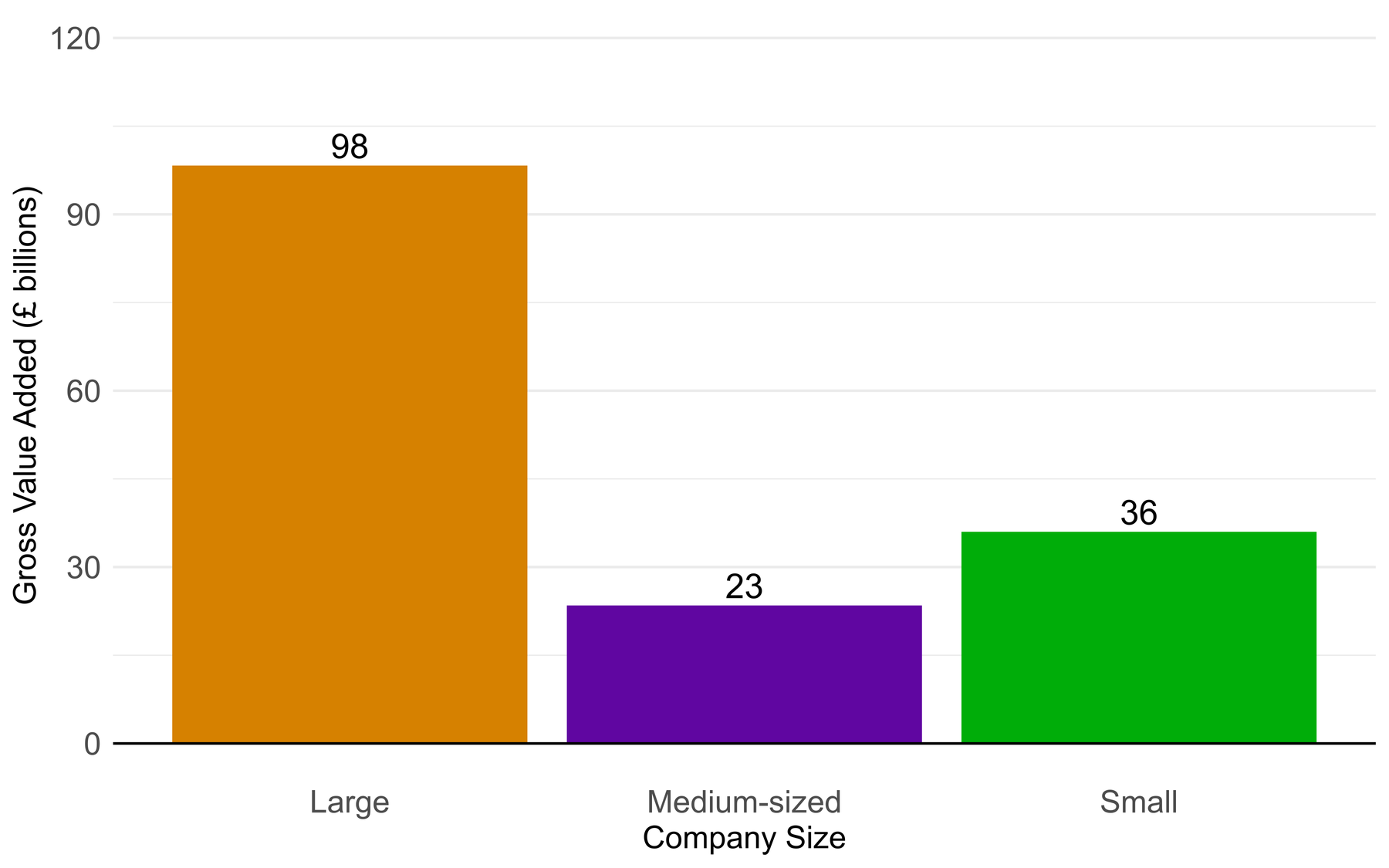
!UK digital and technology sector gross value added by company size in 2024 Figure 2: Large firms supplied almost two-thirds of sector GVA, while small firms contributed more than medium-sized firms. Source: DSIT Economic Statistics, Jun 2026. Official chart published by the source, captured 5 Oct 2026.
What is the sector’s gross value added?
- Digital and Technologies companies produced an estimated £158 billion in GVA in 2024 (DSIT Economic Statistics, Jun 2026).
- The sector’s GVA was equivalent to 6.0% of total UK GVA (DSIT Economic Statistics, Jun 2026).
- Frontier-technology companies produced £70 billion in GVA (DSIT Economic Statistics, Jun 2026).
- Digital Sector employment rose by approximately 38,000 filled jobs between 2024 and 2025 (Digital Employment Estimates, Oct 2026).
- The UK economy added approximately 388,000 filled jobs over the same period (Digital Employment Estimates, Oct 2026).
- Skills England’s earlier workforce overview associated the wider policy sector with approximately £207 billion in 2023 GVA (Skills England, Aug 2026).
- The sector is one of the eight priority sectors in the UK’s Modern Industrial Strategy (Skills England, Aug 2026).
Where is economic value concentrated?
- Large companies generated £98 billion of sector GVA (DSIT Economic Statistics, Jun 2026).
- Small companies generated £36 billion of sector GVA (DSIT Economic Statistics, Jun 2026).
- Medium-sized companies generated £23 billion of sector GVA (DSIT Economic Statistics, Jun 2026).
- Computer programming and consultancy held 58.1% of Digital Sector filled jobs (Digital Employment Estimates, Oct 2026).
- Film, television, video, radio and music held 12.7% of Digital Sector filled jobs (Digital Employment Estimates, Oct 2026).
- Priority occupations overlap most strongly with life sciences, advanced manufacturing, defence and financial services (Skills England, Aug 2026).
- IT managers are priority occupations across four of the assessed growth sectors (Skills England, Aug 2026).
- Information technology directors are priority occupations across three sectors (Skills England, Aug 2026).
How Productive Is the UK Technology Sector?
High productivity is the sector’s strongest economic claim. The official figures also show that productivity does not rise smoothly with company size, so simplistic small-versus-large comparisons miss important differences.
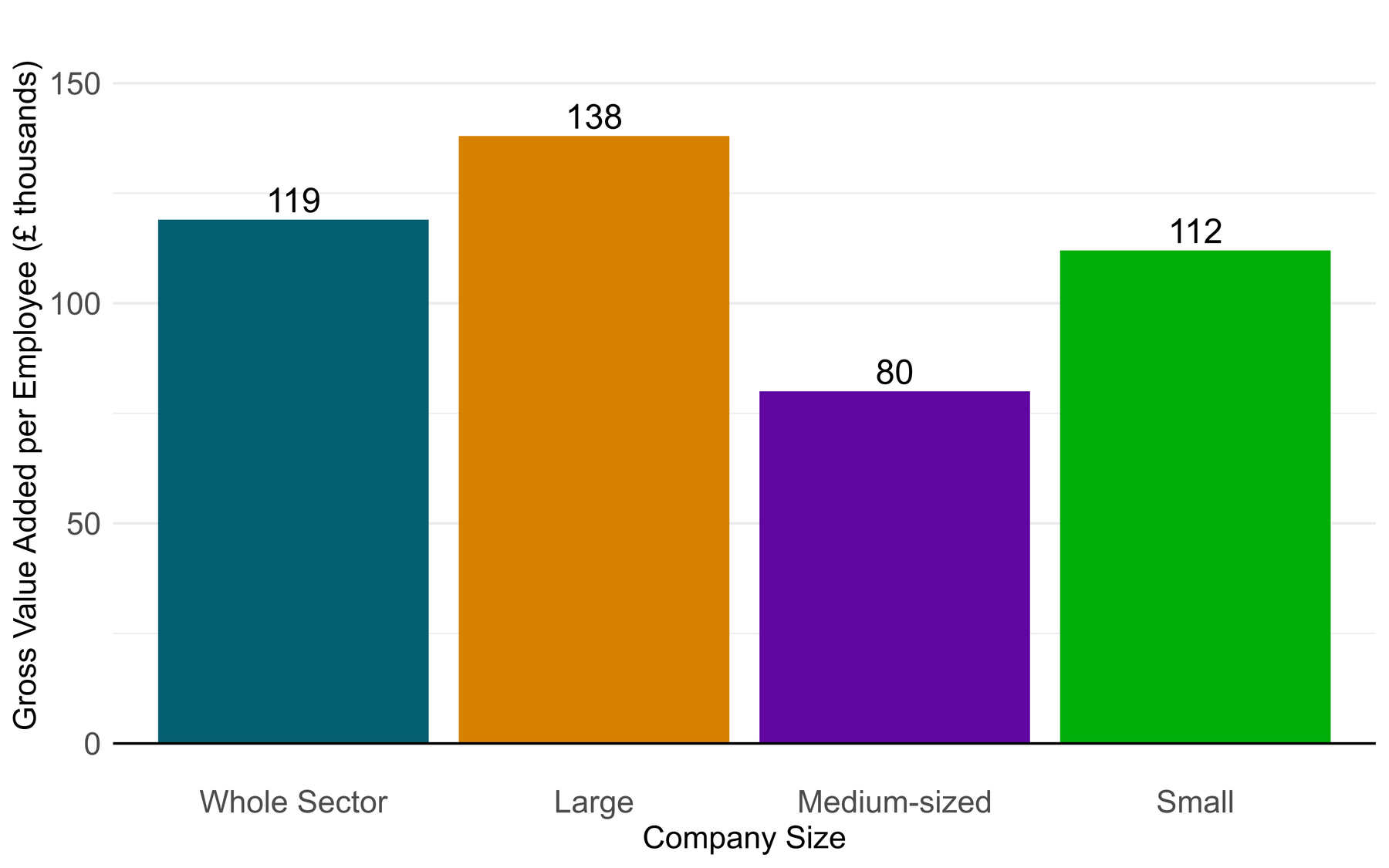
!Gross value added per employee in UK digital and technology companies by size Figure 3: Large firms led productivity, but small firms produced more GVA per employee than medium-sized firms. Source: DSIT Economic Statistics, Jun 2026. Official chart published by the source, captured 5 Oct 2026.
How does productivity compare with the UK average?
- Sector GVA per employee was £41,000 higher than the UK average (DSIT Economic Statistics, Jun 2026).
- The £119,000 sector result was 53.3% above the £78,000 UK benchmark (DSIT Economic Statistics, Jun 2026).
- Frontier-technology productivity averaged £110,000 per employee (DSIT Economic Statistics, Jun 2026).
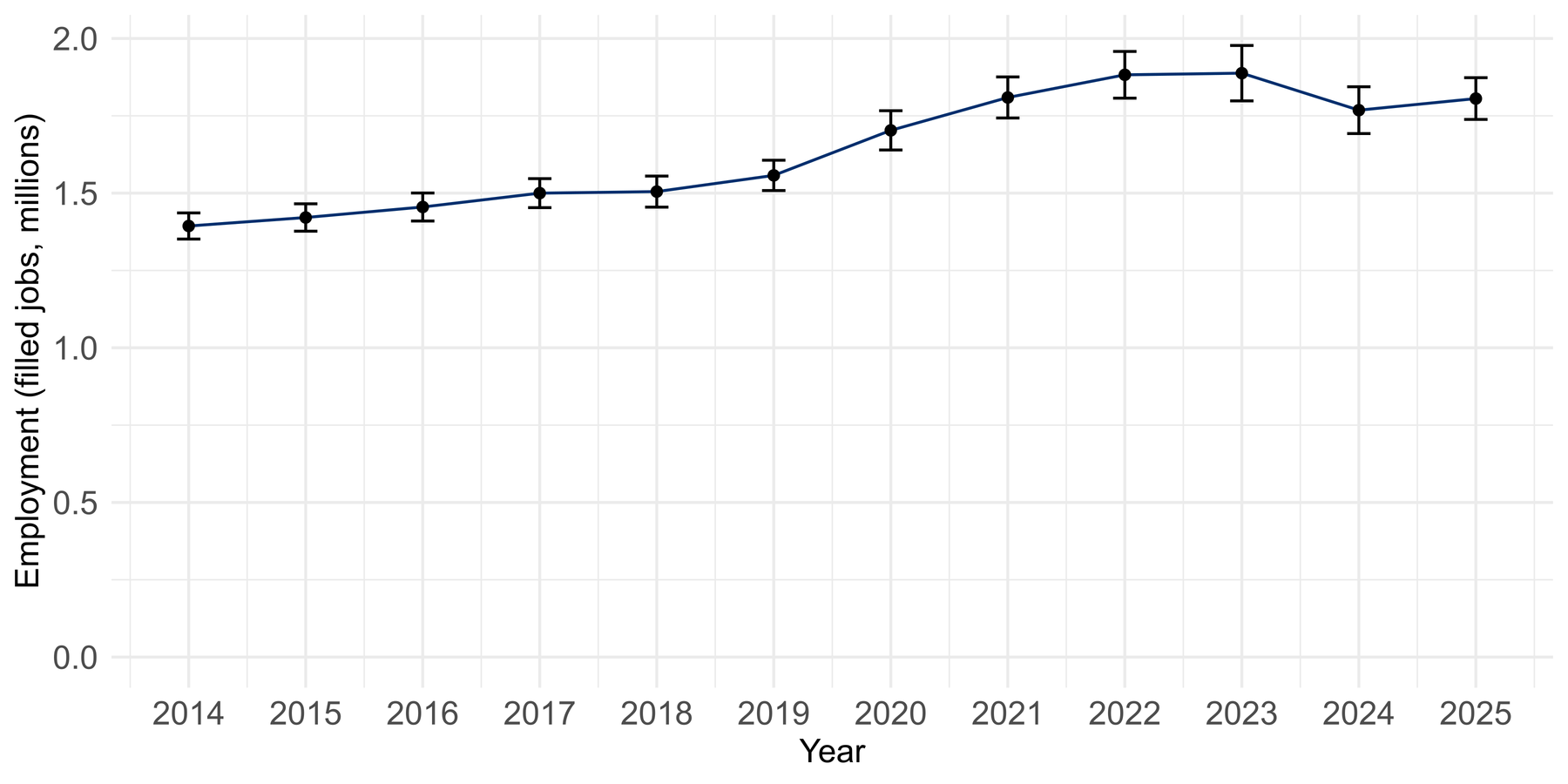
- The Digital Sector employment estimate rose from 1.39 million in 2014 to 1.81 million in 2025 (Digital Employment Estimates, Oct 2026).
- The employment series peaked at approximately 1.89 million filled jobs in 2023 (Digital Employment Estimates, Oct 2026).
- Skills England projects priority-occupation employment to grow 27% between 2025 and 2035 (Skills England, Aug 2026).
- Its lower alternative scenario projects 11% growth over the same period (Skills England, Aug 2026).
What explains the productivity spread?
- Large companies produced £138,000 in GVA per employee (DSIT Economic Statistics, Jun 2026).
- Small companies produced £112,000 in GVA per employee (DSIT Economic Statistics, Jun 2026).
- Medium-sized companies produced £80,000 in GVA per employee (DSIT Economic Statistics, Jun 2026).
- The employment estimate’s confidence-interval width increased from roughly 100,000 jobs in 2019 to 130,000 in 2025 (Digital Employment Estimates, Oct 2026).
- Employment estimates suppress demographic breakdowns based on three or fewer survey responses (Digital Employment Estimates, Oct 2026).
- The central workforce-demand scenario adds 239,300 jobs compared with 94,100 in the alternative scenario (Skills England, Aug 2026).
- Skills England warns that accelerated AI adoption could make projections for AI-exposed digital occupations too high (Skills England, Aug 2026).
- The projections assume long-run growth resembling the Digital Sector’s pattern between 2011 and 2024 (Skills England, Aug 2026).
How Many People Work in UK Technology?
The headline job count hides a sector in motion. Programming remains dominant, but media and publishing supplied much of the latest growth while hardware manufacturing contracted sharply.
!UK Digital Sector filled jobs from 2014 to 2025 with confidence intervals Figure 4: Digital employment recovered in 2025 after falling in 2024, although statistical uncertainty is wider than before 2019. Source: Digital Employment Estimates, Oct 2026. Official chart published by the source, captured 5 Oct 2026.
Which subsectors are growing?
- Large Digital and Technologies companies employed approximately 712,000 people (DSIT Economic Statistics, Jun 2026).
- Small companies employed approximately 320,000 people (DSIT Economic Statistics, Jun 2026).
- Medium-sized companies employed approximately 293,000 people (DSIT Economic Statistics, Jun 2026).
- Media employment increased by approximately 23,000 jobs, or 11.1%, in 2025 (Digital Employment Estimates, Oct 2026).
- Programming and consultancy employment increased by approximately 17,000 jobs, or 1.6% (Digital Employment Estimates, Oct 2026).
- The central scenario requires 239,000 additional workers in priority occupations (Skills England, Aug 2026).
- Replacement demand adds another 249,000 workers over 2026 to 2035 (Skills England, Aug 2026).
Which subsectors are shrinking?
- Frontier-technology companies employed approximately 637,000 people (DSIT Economic Statistics, Jun 2026).
- Large frontier-technology companies employed 472,000 people, or 74.1% of that workforce (DSIT Economic Statistics, Jun 2026).
- Small and medium frontier firms employed approximately 61,000 and 104,000 people respectively (DSIT Economic Statistics, Jun 2026).
- Electronics and computer manufacturing lost approximately 18,000 filled jobs, an 18% fall (Digital Employment Estimates, Oct 2026).
- Computer and communication-equipment repair lost about 3,000 jobs, a 12.5% fall (Digital Employment Estimates, Oct 2026).
- Skills England estimates an average 24,900 replacement workers will be needed each year (Skills England, Aug 2026).
- Twenty-five percent of priority occupations are already in critical demand (Skills England, Aug 2026).
- The future-demand model holds projected declines at zero rather than allowing negative employment demand (Skills England, Aug 2026).
What Do UK Technology Jobs Pay?
Technology pay is comfortably above the national benchmark, but employer size and occupation matter. The figures should be read as evidence of a premium, not as a promise that every role pays the sector average.
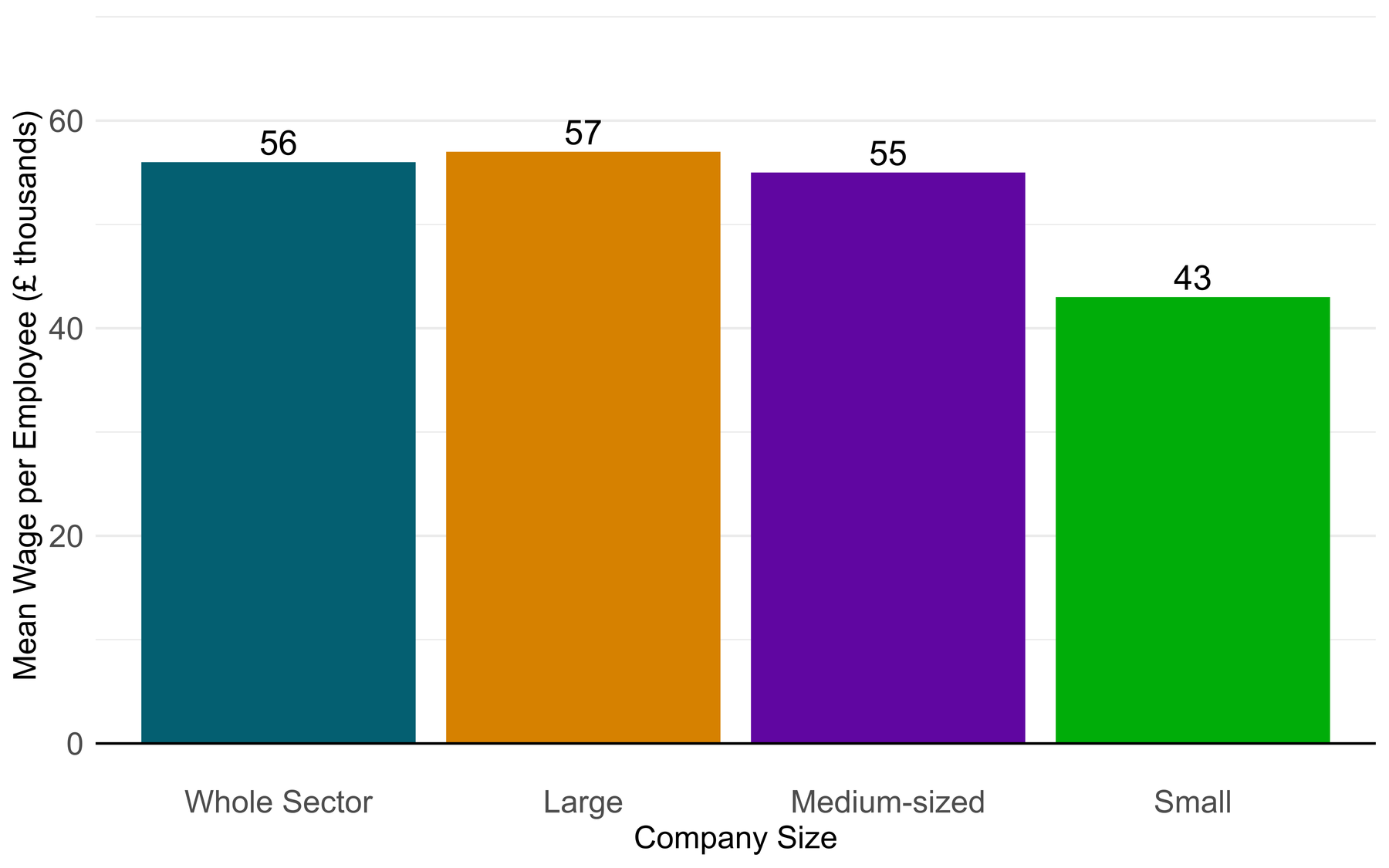
!Mean wage per employee in UK digital and technology companies by size Figure 5: Average pay was similar at large and medium-sized firms, while small-company pay was materially lower. Source: DSIT Economic Statistics, Jun 2026. Official chart published by the source, captured 5 Oct 2026.
How large is the technology pay premium?
- The £56,000 sector average was £19,000 above median earnings across all industries (DSIT Economic Statistics, Jun 2026).
- The measured pay premium was 49.6% (DSIT Economic Statistics, Jun 2026).
- Frontier-technology companies averaged about £58,000 per employee (DSIT Economic Statistics, Jun 2026).
- Publishing was the only Digital subsector where women’s employment share exceeded the UK-wide share (Digital Employment Estimates, Oct 2026).
- Women held 53.5% of publishing jobs compared with 48.3% of all UK filled jobs (Digital Employment Estimates, Oct 2026).
- Digital and technology priority occupations require digital-literacy proficiency of 4.8 on a five-point scale (Skills England, Aug 2026).
- The economy-wide weighted digital-literacy requirement is 3.2 (Skills England, Aug 2026).
How does pay vary by company size and skill?
- Large companies averaged £57,000 in wages per employee (DSIT Economic Statistics, Jun 2026).
- Medium-sized companies averaged £55,000 (DSIT Economic Statistics, Jun 2026).
- Small companies averaged £43,000 (DSIT Economic Statistics, Jun 2026).
- People aged 25 to 34 held 28.7% of Digital Sector jobs versus 22.8% across the UK (Digital Employment Estimates, Oct 2026).
- People aged 35 to 44 held 27.0% of Digital Sector jobs versus 22.3% nationally (Digital Employment Estimates, Oct 2026).
- Priority occupations require learning-and-investigating proficiency of 3.9 versus 3.2 economy-wide (Skills England, Aug 2026).
- They require creating proficiency of 3.5 versus 2.7 economy-wide (Skills England, Aug 2026).
Is the Sector Dominated by Small or Large Firms?
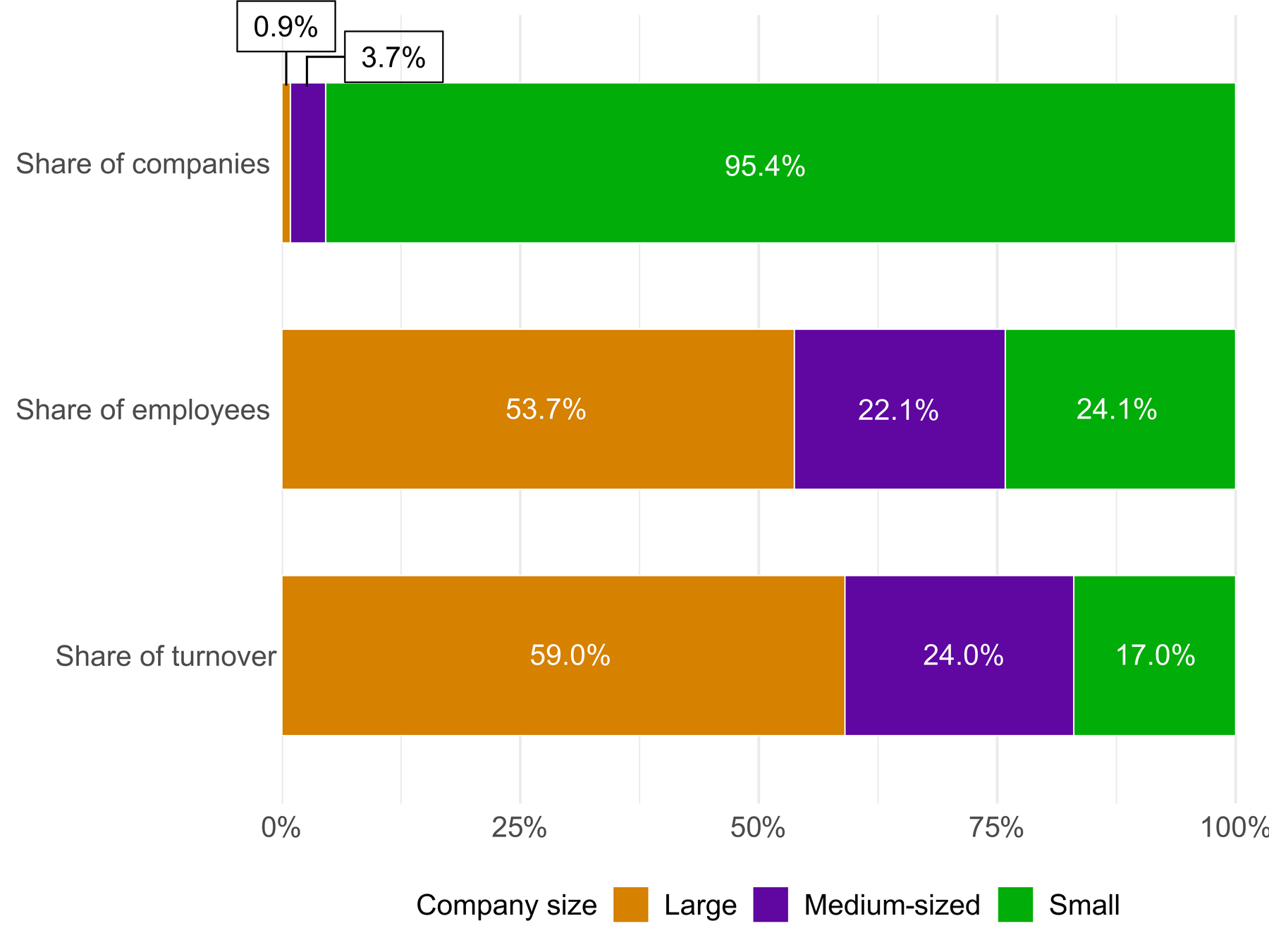
The sector has a classic long-tail structure: almost every company is small, yet a narrow group of large businesses controls most employment, turnover and GVA. Frontier technologies are even more concentrated.
!Shares of UK digital and technology companies, employment and turnover by company size Figure 6: Small firms dominated the company count, but large firms controlled most jobs and turnover. Source: DSIT Economic Statistics, Jun 2026. Official chart published by the source, captured 5 Oct 2026.
How concentrated are jobs and turnover?
- Small companies accounted for 95.4% of the sector’s company count (DSIT Economic Statistics, Jun 2026).
- Large companies held 53.7% of sector employment (DSIT Economic Statistics, Jun 2026).
- Medium-sized companies held 22.1% of sector employment (DSIT Economic Statistics, Jun 2026).
- London contained approximately 470,000 Digital Sector filled jobs (Digital Employment Estimates, Oct 2026).
- The South East contained approximately 327,000 Digital Sector filled jobs (Digital Employment Estimates, Oct 2026).
- Central London Forward recorded a 14.1% local concentration of digital and technology employment (Skills England, Aug 2026).
- Thames Valley Berkshire recorded a 16.1% local concentration (Skills England, Aug 2026).
Is frontier technology more concentrated?
- Large companies generated 59.0% of broad-sector turnover (DSIT Economic Statistics, Jun 2026).
- Medium-sized companies generated 24.0% and small companies 17.0% of turnover (DSIT Economic Statistics, Jun 2026).
- Large frontier firms generated £172 billion, or 72.7%, of frontier turnover (DSIT Economic Statistics, Jun 2026).
- London’s share of Digital Sector employment rose 0.8 percentage points in 2025 (Digital Employment Estimates, Oct 2026).
- The North East recorded the fastest regional Digital Sector employment growth at 24.3% (Digital Employment Estimates, Oct 2026).
- The seven leading education routes account for 44% of education leavers entering priority occupations (Skills England, Aug 2026).
- Skills England links 108 apprenticeship standards to the sector’s priority occupations (Skills England, Aug 2026).
Methodology and Sources
Statistics were selected from the newest accessible primary releases published by the UK government and Skills England. The article keeps the broad Digital and Technologies company definition separate from the narrower Digital Sector employment definition, attributes forecasts as scenarios rather than certainties, and will be checked monthly for revisions or newer releases.
Glossary
- D&T: Digital and Technologies, the broad company and policy sector used by DSIT.
- Digital Sector: The narrower industrial grouping used in the government’s employment series.
- GVA: Gross value added, the value generated after subtracting intermediate inputs.
- Filled job: An employee job or self-employment job occupied during the reference period.
- Priority occupation: An occupation identified as important to one or more Industrial Strategy sectors.
- Replacement demand: Workers needed to replace people leaving an occupation, separate from expansion.
- SIC: Standard Industrial Classification.
- SOC: Standard Occupational Classification.
Sources
- DSIT Economic Statistics, Jun 2026.
- Digital Employment Estimates, Oct 2026.
- Skills England, Aug 2026.
Discussion