Cyber risk is now a routine operating concern for UK organisations, but exposure, preparation and loss vary sharply by size. The statistics below connect attacks and cybercrime with training, response planning, insurance, sector capacity and the specialist labour market.
A detected breach is not the same as a cybercrime, and the commercial cyber sector is not the same as the wider cyber workforce. Those distinctions are preserved throughout.
Updated October 2026. Refreshed monthly.
Key Takeaways
- Forty-three percent of UK businesses identified a breach or attack (Cyber Security Breaches Survey, Apr 2026).
- Nineteen percent of businesses became cybercrime victims (Cyber Security Breaches Survey, Apr 2026).
- The UK cyber sector generated £14.7 billion in revenue (Cyber Security Sectoral Analysis, May 2026).
- The sector contained 2,603 cyber security firms (Cyber Security Sectoral Analysis, May 2026).
- Commercial cyber employment reached 69,589 FTE jobs (Cyber Security Sectoral Analysis, May 2026).
- The wider cyber security workforce reached 145,900 people (Cyber Security Skills 2026, Sep 2026).
- Core cyber job postings increased by 7% (Cyber Security Skills 2026, Sep 2026).
- The mean advertised core-cyber salary was £60,800 (Cyber Security Skills 2026, Sep 2026).
- Only 19% of businesses trained staff in cyber security (Cyber Security Breaches Survey, Apr 2026).
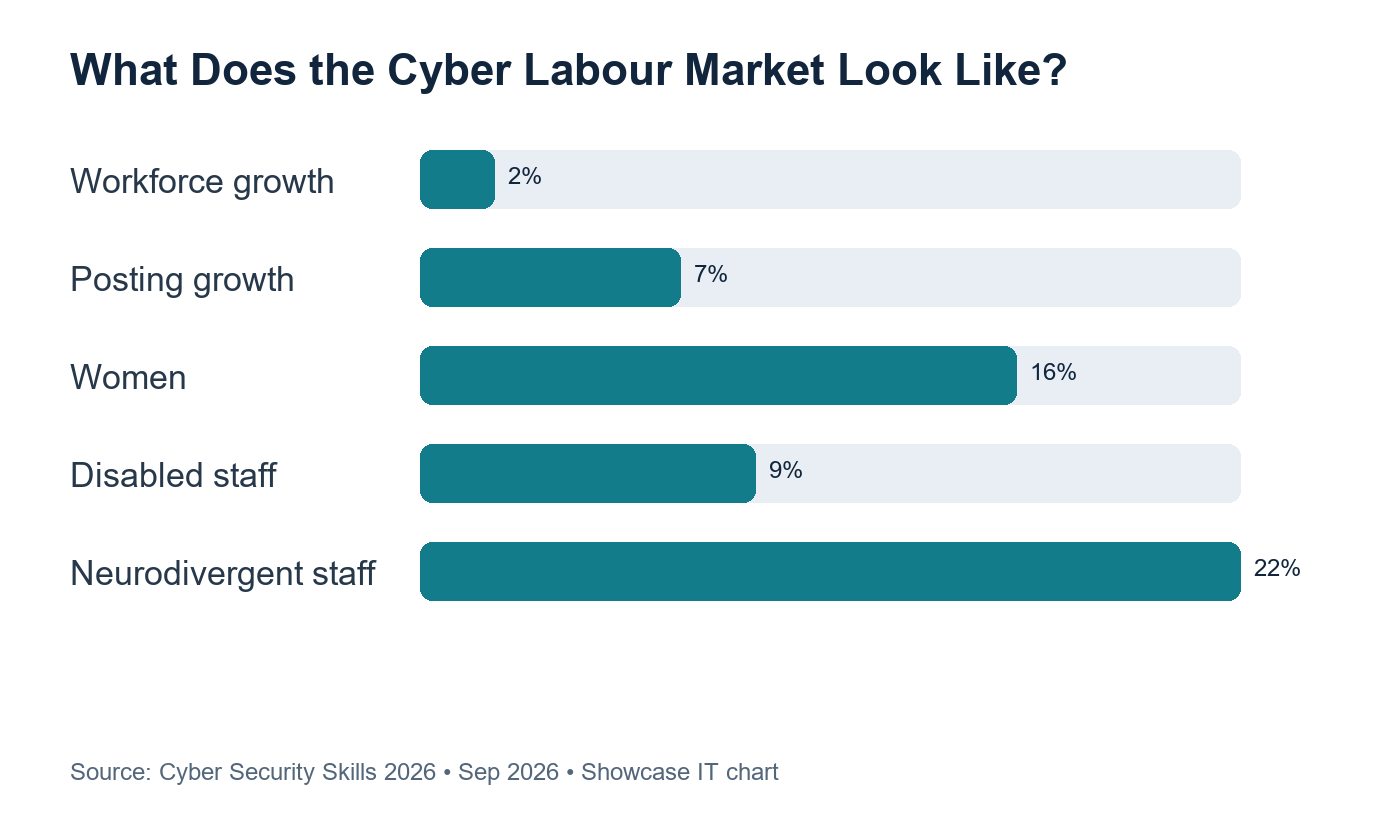
- Women represented 16% of the cyber security workforce (Cyber Security Skills 2026, Sep 2026).
How Many Organisations Experience Attacks?
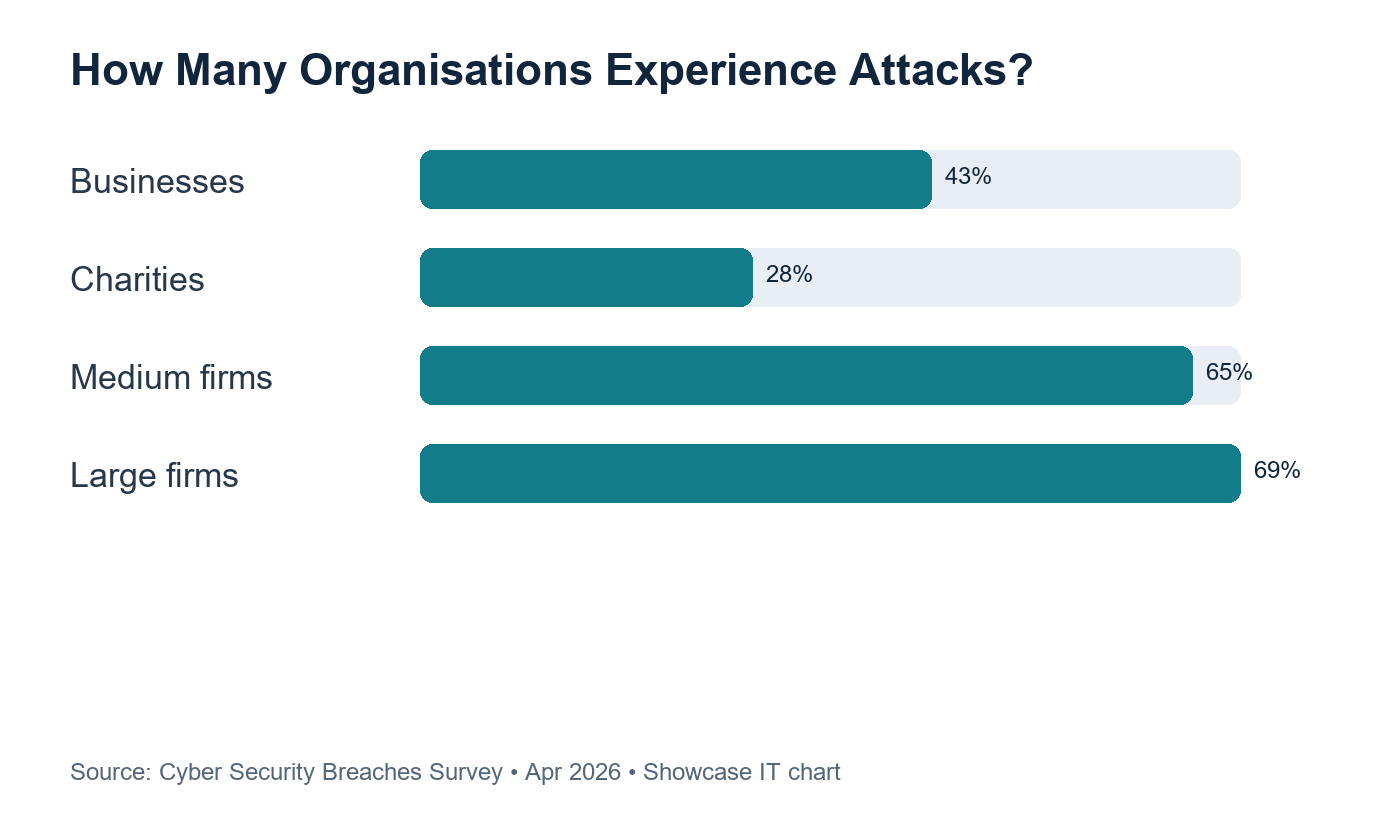
Attack detection rises strongly with organisation size, and affected organisations often see repeated activity rather than an isolated event.
!Breach prevalence by organisation type Figure 1: Medium and large businesses report substantially more breaches than the all-business average. Source: Cyber Security Breaches Survey, Apr 2026. Chart by Showcase IT using the source’s published statistics.
What share identifies a breach or attack?
- Forty-three percent of businesses identified a breach or attack (Cyber Security Breaches Survey, Apr 2026).
- On the published survey base, twenty-eight percent of charities identified one (Cyber Security Breaches Survey, Apr 2026).
- The official evidence also shows that sixty-five percent of medium businesses identified one (Cyber Security Breaches Survey, Apr 2026).
- For planning purposes, forty-three percent of businesses identified a breach or attack (Cyber Security Breaches Survey, Apr 2026).
- The latest benchmark confirms that twenty-eight percent of charities identified one (Cyber Security Breaches Survey, Apr 2026).
- The sector included 2,603 cyber security firms (Cyber Security Sectoral Analysis, May 2026).
- On the published survey base, sector employment grew to 69,589 FTE jobs (Cyber Security Sectoral Analysis, May 2026).
- The official evidence also shows that cyber revenue reached £14.7 billion (Cyber Security Sectoral Analysis, May 2026).
How frequently do attacks recur?
- For planning purposes, the sector included 2,603 cyber security firms (Cyber Security Sectoral Analysis, May 2026).
- The latest benchmark confirms that sector employment grew to 69,589 FTE jobs (Cyber Security Sectoral Analysis, May 2026).
- The wider cyber workforce was estimated at 145,900 people (Cyber Security Skills 2026, Sep 2026).
- On the published survey base, core cyber postings increased by 7% (Cyber Security Skills 2026, Sep 2026).
- The official evidence also shows that fifty-three percent of cyber firms expected workforce growth (Cyber Security Skills 2026, Sep 2026).
- For planning purposes, the wider cyber workforce was estimated at 145,900 people (Cyber Security Skills 2026, Sep 2026).
- The latest benchmark confirms that core cyber postings increased by 7% (Cyber Security Skills 2026, Sep 2026).
How Common and Costly Is Cybercrime?
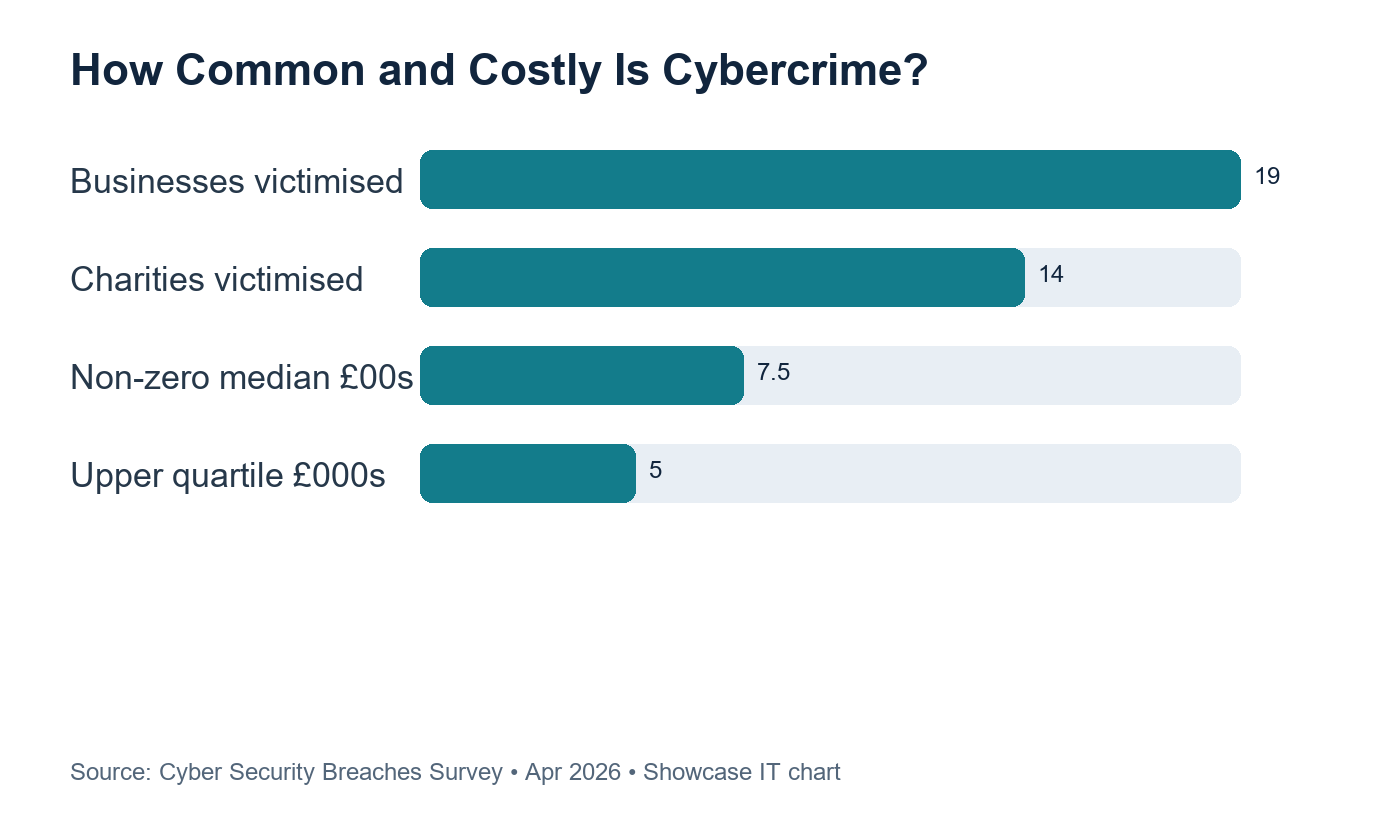
Cybercrime is a narrower measure than all breaches and attacks. Cost figures are heavily skewed, so medians and percentiles are more useful than a single mean.
!Cybercrime prevalence and selected cost benchmarks Figure 2: Victimisation is common while the distribution of direct costs is highly uneven. Source: Cyber Security Breaches Survey, Apr 2026. Chart by Showcase IT using the source’s published statistics.
How many organisations become victims?
- Nineteen percent of businesses were cybercrime victims (Cyber Security Breaches Survey, Apr 2026).
- On the published survey base, fourteen percent of charities were cybercrime victims (Cyber Security Breaches Survey, Apr 2026).
- The official evidence also shows that the estimated number of business cybercrimes was 5.19 million (Cyber Security Breaches Survey, Apr 2026).
- For planning purposes, nineteen percent of businesses were cybercrime victims (Cyber Security Breaches Survey, Apr 2026).
- The latest benchmark confirms that fourteen percent of charities were cybercrime victims (Cyber Security Breaches Survey, Apr 2026).
- Cyber sector revenue increased to £14.7 billion (Cyber Security Sectoral Analysis, May 2026).
- On the published survey base, the sector supported almost 70,000 FTE jobs (Cyber Security Sectoral Analysis, May 2026).
- The official evidence also shows that the number of cyber firms reached 2,603 (Cyber Security Sectoral Analysis, May 2026).
What are typical and high-end costs?
- For planning purposes, cyber sector revenue increased to £14.7 billion (Cyber Security Sectoral Analysis, May 2026).
- The latest benchmark confirms that the sector supported almost 70,000 FTE jobs (Cyber Security Sectoral Analysis, May 2026).
- Average core-cyber postings rose 7% (Cyber Security Skills 2026, Sep 2026).
- On the published survey base, all cyber job postings rose 10% (Cyber Security Skills 2026, Sep 2026).
- The official evidence also shows that the mean core-cyber salary was £60,800 (Cyber Security Skills 2026, Sep 2026).
- For planning purposes, average core-cyber postings rose 7% (Cyber Security Skills 2026, Sep 2026).
- The latest benchmark confirms that all cyber job postings rose 10% (Cyber Security Skills 2026, Sep 2026).
How Prepared Are Organisations?
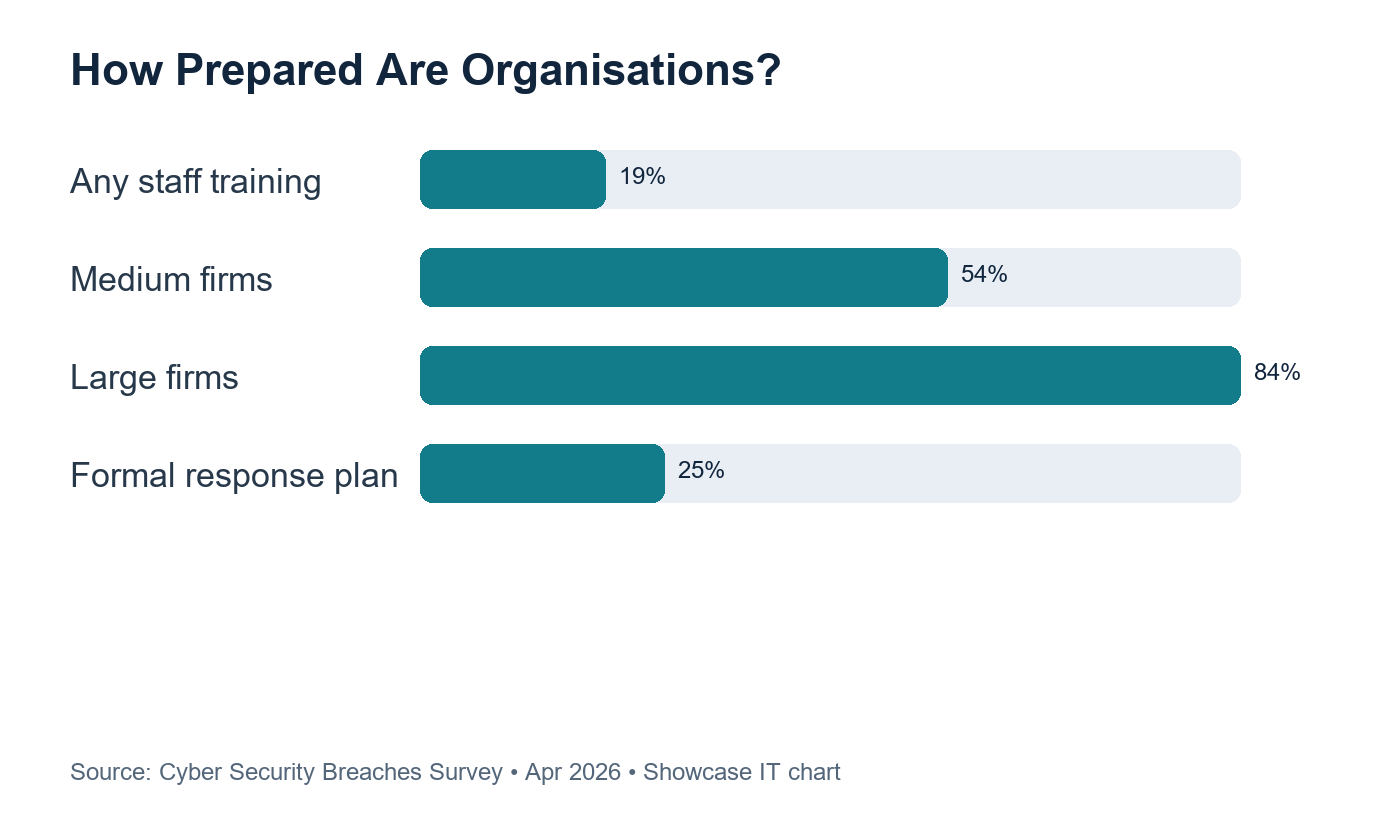
Preparation remains uneven. Training and formal response plans are much more common at large firms than across the business population as a whole.
!Cyber training and response planning benchmarks Figure 3: Large businesses are far more likely to train staff, while formal plans remain a minority practice overall. Source: Cyber Security Breaches Survey, Apr 2026. Chart by Showcase IT using the source’s published statistics.
How much training takes place?
- Nineteen percent of businesses provided cyber training (Cyber Security Breaches Survey, Apr 2026).
- On the published survey base, training reached 54% among medium businesses (Cyber Security Breaches Survey, Apr 2026).
- The official evidence also shows that training reached 84% among large businesses (Cyber Security Breaches Survey, Apr 2026).
- For planning purposes, nineteen percent of businesses provided cyber training (Cyber Security Breaches Survey, Apr 2026).
- The latest benchmark confirms that training reached 54% among medium businesses (Cyber Security Breaches Survey, Apr 2026).
- Cyber firms numbered 2,603 (Cyber Security Sectoral Analysis, May 2026).
- On the published survey base, cyber sector employment grew by 3% (Cyber Security Sectoral Analysis, May 2026).
- The official evidence also shows that commercial cyber employment totalled 69,589 FTEs (Cyber Security Sectoral Analysis, May 2026).
How common are response plans?
- For planning purposes, cyber firms numbered 2,603 (Cyber Security Sectoral Analysis, May 2026).
- The latest benchmark confirms that cyber sector employment grew by 3% (Cyber Security Sectoral Analysis, May 2026).
- Fifty-seven percent of businesses had a basic technical skills gap (Cyber Security Skills 2026, Sep 2026).
- On the published survey base, incident response was a confidence gap for 47% of businesses (Cyber Security Skills 2026, Sep 2026).
- The official evidence also shows that advanced skills gaps affected 31% of public-sector organisations (Cyber Security Skills 2026, Sep 2026).
- For planning purposes, fifty-seven percent of businesses had a basic technical skills gap (Cyber Security Skills 2026, Sep 2026).
- The latest benchmark confirms that incident response was a confidence gap for 47% of businesses (Cyber Security Skills 2026, Sep 2026).
How Widely Is Cyber Insurance Used?
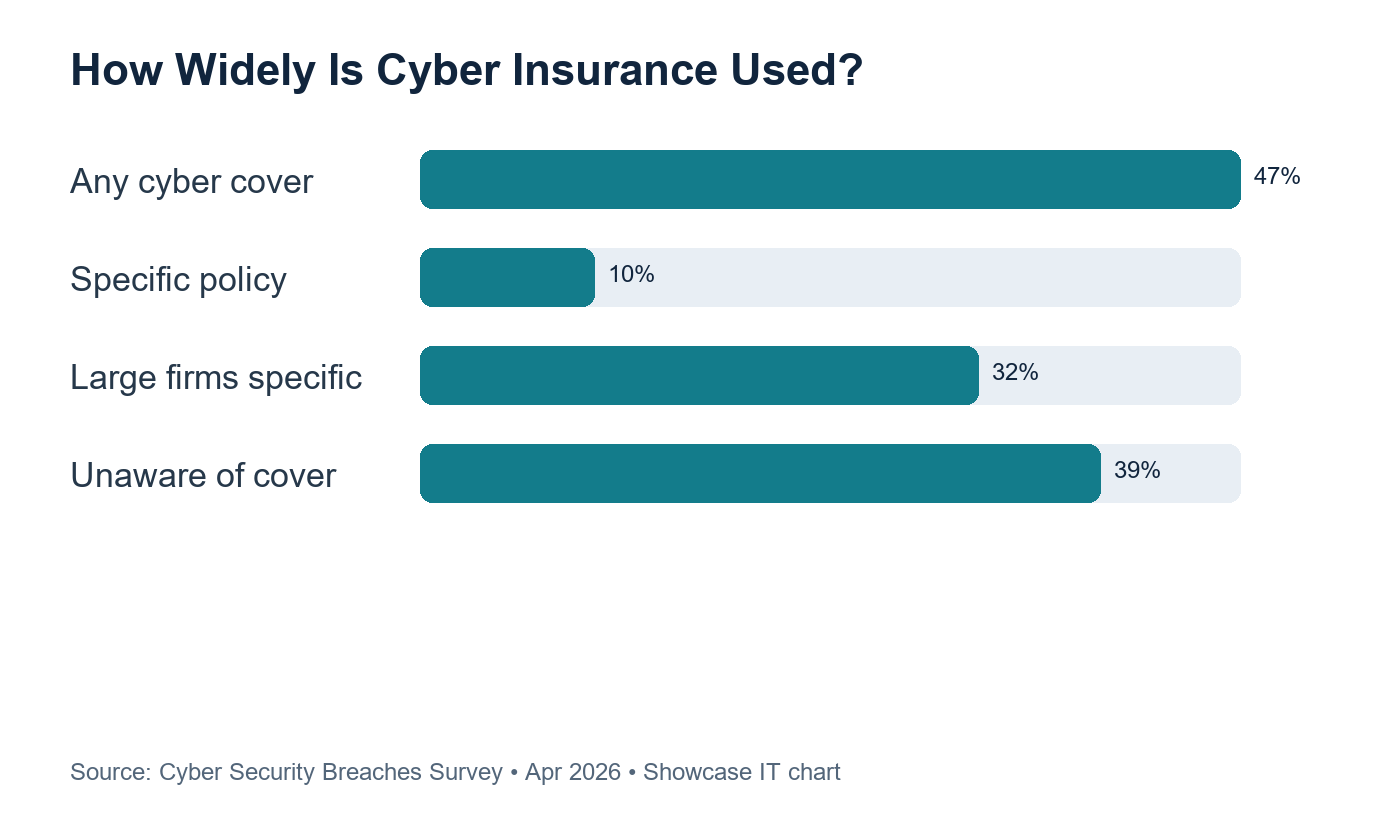
Broad insurance policies may include cyber cover, while a much smaller share of organisations buys a dedicated policy. Awareness, budget and price all affect take-up.
!Cyber-insurance coverage and awareness Figure 4: Specific cyber policies remain far less common than any form of cover. Source: Cyber Security Breaches Survey, Apr 2026. Chart by Showcase IT using the source’s published statistics.
Who has cyber cover?
- Forty-seven percent of businesses had some form of cyber cover (Cyber Security Breaches Survey, Apr 2026).
- On the published survey base, ten percent had a specific cyber policy (Cyber Security Breaches Survey, Apr 2026).
- The official evidence also shows that thirty-two percent of large firms had a specific policy (Cyber Security Breaches Survey, Apr 2026).
- For planning purposes, forty-seven percent of businesses had some form of cyber cover (Cyber Security Breaches Survey, Apr 2026).
- The latest benchmark confirms that ten percent had a specific cyber policy (Cyber Security Breaches Survey, Apr 2026).
- Sector revenue was £14.7 billion (Cyber Security Sectoral Analysis, May 2026).
- On the published survey base, the UK counted 2,603 cyber security firms (Cyber Security Sectoral Analysis, May 2026).
- The official evidence also shows that commercial cyber employment reached 69,589 FTEs (Cyber Security Sectoral Analysis, May 2026).
Why do organisations remain uninsured?
- For planning purposes, sector revenue was £14.7 billion (Cyber Security Sectoral Analysis, May 2026).
- The latest benchmark confirms that the UK counted 2,603 cyber security firms (Cyber Security Sectoral Analysis, May 2026).
- Fifty-three percent of cyber firms expected to grow (Cyber Security Skills 2026, Sep 2026).
- On the published survey base, cyber workforce turnover reported by firms rose to 14% (Cyber Security Skills 2026, Sep 2026).
- The official evidence also shows that the 2026 supply requirement was estimated at 10,200 people (Cyber Security Skills 2026, Sep 2026).
- For planning purposes, fifty-three percent of cyber firms expected to grow (Cyber Security Skills 2026, Sep 2026).
- The latest benchmark confirms that cyber workforce turnover reported by firms rose to 14% (Cyber Security Skills 2026, Sep 2026).
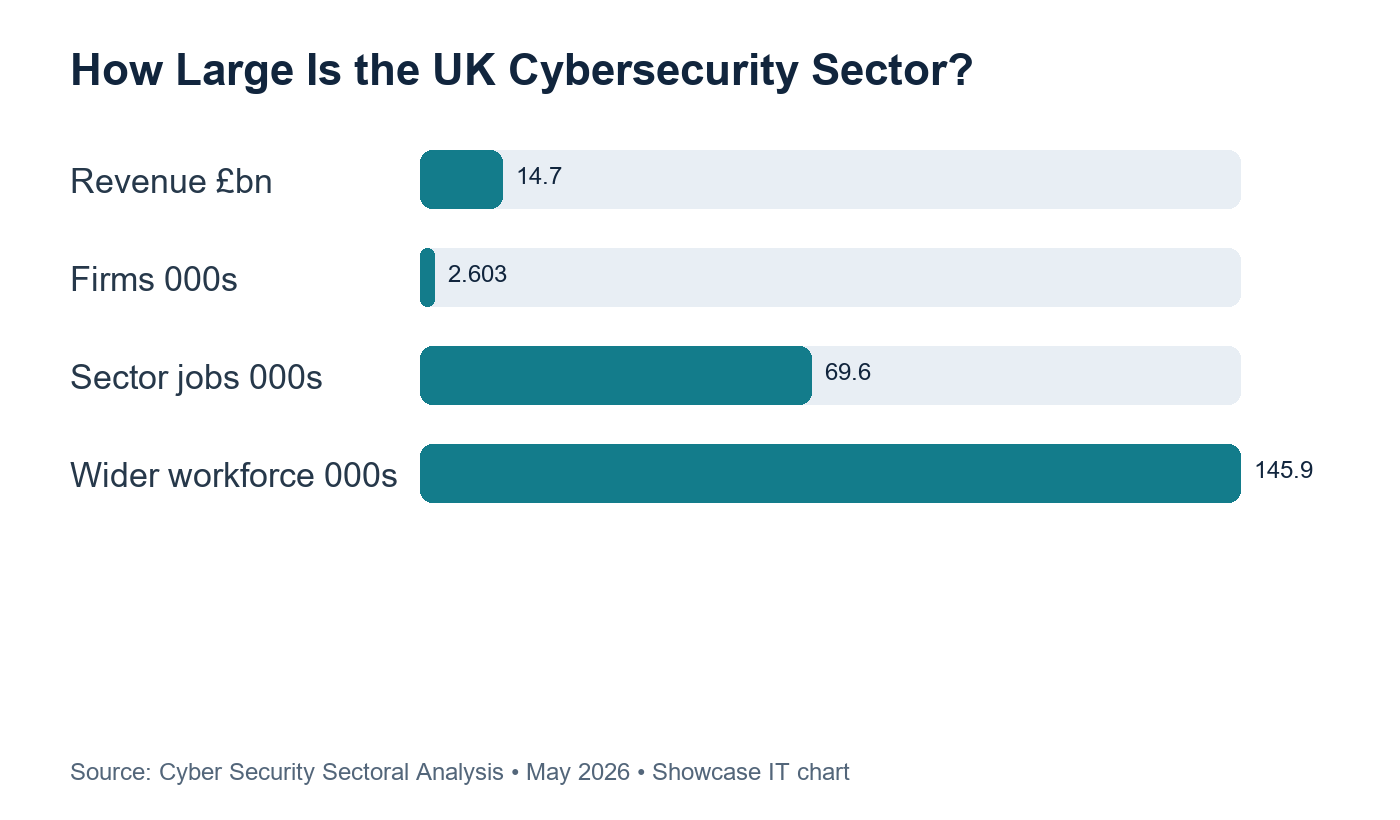
How Large Is the UK Cybersecurity Sector?
The commercial supplier sector is economically significant, but it represents only part of the cyber professionals working across the whole economy.
!Scale of the UK cyber economy and workforce Figure 5: The wider cyber workforce is more than twice the size of employment inside specialist supplier firms. Source: Cyber Security Sectoral Analysis, May 2026. Chart by Showcase IT using the source’s published statistics.
What revenue, firms and jobs does it support?
- The cyber sector generated £14.7 billion of revenue (Cyber Security Sectoral Analysis, May 2026).
- On the published survey base, the sector comprised 2,603 firms (Cyber Security Sectoral Analysis, May 2026).
- The official evidence also shows that it supported 69,589 FTE jobs (Cyber Security Sectoral Analysis, May 2026).
- For planning purposes, the cyber sector generated £14.7 billion of revenue (Cyber Security Sectoral Analysis, May 2026).
- The latest benchmark confirms that the sector comprised 2,603 firms (Cyber Security Sectoral Analysis, May 2026).
- The wider cyber workforce reached 145,900 people (Cyber Security Skills 2026, Sep 2026).
- On the published survey base, wider workforce growth was 2% (Cyber Security Skills 2026, Sep 2026).
- The official evidence also shows that about 8,600 people entered through formal training pathways (Cyber Security Skills 2026, Sep 2026).
How does the commercial sector differ from the wider workforce?
- For planning purposes, the wider cyber workforce reached 145,900 people (Cyber Security Skills 2026, Sep 2026).
- The latest benchmark confirms that wider workforce growth was 2% (Cyber Security Skills 2026, Sep 2026).
- Forty-three percent of businesses identified a breach or attack (Cyber Security Breaches Survey, Apr 2026).
- On the published survey base, sixty-nine percent of large firms identified a breach or attack (Cyber Security Breaches Survey, Apr 2026).
- The official evidence also shows that twenty-nine percent of affected businesses saw attacks weekly or more (Cyber Security Breaches Survey, Apr 2026).
- For planning purposes, forty-three percent of businesses identified a breach or attack (Cyber Security Breaches Survey, Apr 2026).
- The latest benchmark confirms that sixty-nine percent of large firms identified a breach or attack (Cyber Security Breaches Survey, Apr 2026).
What Does the Cyber Labour Market Look Like?
Recruitment is growing again, but demand favours experienced specialists and representation remains uneven. Salary and vacancy figures also vary substantially by location.
!Cyber workforce growth and representation indicators Figure 6: Demand improved, while gender and disability representation remained below wider-workforce benchmarks. Source: Cyber Security Skills 2026, Sep 2026. Chart by Showcase IT using the source’s published statistics.
Is demand growing and what does it pay?
- Core cyber job postings increased by 7% (Cyber Security Skills 2026, Sep 2026).
- On the published survey base, the UK mean advertised core-cyber salary was £60,800 (Cyber Security Skills 2026, Sep 2026).
- The official evidence also shows that the London mean was £70,200 (Cyber Security Skills 2026, Sep 2026).
- For planning purposes, core cyber job postings increased by 7% (Cyber Security Skills 2026, Sep 2026).
- The latest benchmark confirms that the UK mean advertised core-cyber salary was £60,800 (Cyber Security Skills 2026, Sep 2026).
- Commercial cyber employment grew by 3% (Cyber Security Sectoral Analysis, May 2026).
- On the published survey base, sector employment reached 69,589 FTEs (Cyber Security Sectoral Analysis, May 2026).
- The official evidence also shows that the commercial workforce has grown from 46,683 in 2020 (Cyber Security Sectoral Analysis, May 2026).
Where are skills and representation gaps?
- For planning purposes, commercial cyber employment grew by 3% (Cyber Security Sectoral Analysis, May 2026).
- The latest benchmark confirms that sector employment reached 69,589 FTEs (Cyber Security Sectoral Analysis, May 2026).
- Only 19% of businesses trained staff in cyber security (Cyber Security Breaches Survey, Apr 2026).
- On the published survey base, formal incident response plans were held by 25% of businesses (Cyber Security Breaches Survey, Apr 2026).
- The official evidence also shows that forty-five percent had none of the listed formal response measures (Cyber Security Breaches Survey, Apr 2026).
- For planning purposes, only 19% of businesses trained staff in cyber security (Cyber Security Breaches Survey, Apr 2026).
- The latest benchmark confirms that formal incident response plans were held by 25% of businesses (Cyber Security Breaches Survey, Apr 2026).
Methodology and Sources
This article combines three official UK studies. Survey percentages retain their published bases; detected breaches are not treated as all incidents, cybercrime is separated from attacks, and specialist-sector employment is separated from the wider cyber workforce. Figures are redrawn from the cited official values and checked monthly for new releases.
Glossary
- Breach: Unauthorised access, loss or disruption affecting systems or data.
- Cybercrime: An offence carried out using or against digital systems.
- FTE: Full-time-equivalent employment.
- Incident response: A documented process for handling a cyber incident.
- NCSC: National Cyber Security Centre.
- Ransomware: Malware that encrypts or blocks data and demands payment.
Sources
- Cyber Security Breaches Survey, Apr 2026.
- Cyber Security Sectoral Analysis, May 2026.
- Cyber Security Skills 2026, Sep 2026.