AI adoption is rising quickly, but the headline rate depends on business size, survey scope and the definition of use. This article separates experimentation from depth, employee use from employer reporting, and economy-wide adoption from the specialist AI sector.
The evidence points to rapid diffusion of generative tools alongside slower integration into multiple business functions.
Updated October 2026. Refreshed monthly.
Key Takeaways
- About 35% of businesses with 10 or more employees used AI in June 2026 (ONS AI in UK Businesses, Jul 2026).
- The comparable late-2023 rate was about 12% (ONS AI in UK Businesses, Jul 2026).
- Sixteen percent of all surveyed businesses currently used AI (DSIT AI Adoption Research, Feb 2026).
- Large-business adoption reached 36% (DSIT AI Adoption Research, Feb 2026).
- Natural-language processing or text generation was used by 85% of adopters (DSIT AI Adoption Research, Feb 2026).
- The UK AI sector contained more than 5,800 companies (AI Sector Study 2024, Sep 2025).
- AI-sector revenue reached £23.9 billion (AI Sector Study 2024, Sep 2025).
- AI-sector GVA reached £11.8 billion (AI Sector Study 2024, Sep 2025).
- Fifty-five percent of surveyed employees reported using AI (ONS AI in UK Businesses, Jul 2026).
- Only 11% of businesses said most workers had received AI training (ONS AI in UK Businesses, Jul 2026).
How Many UK Businesses Use AI?
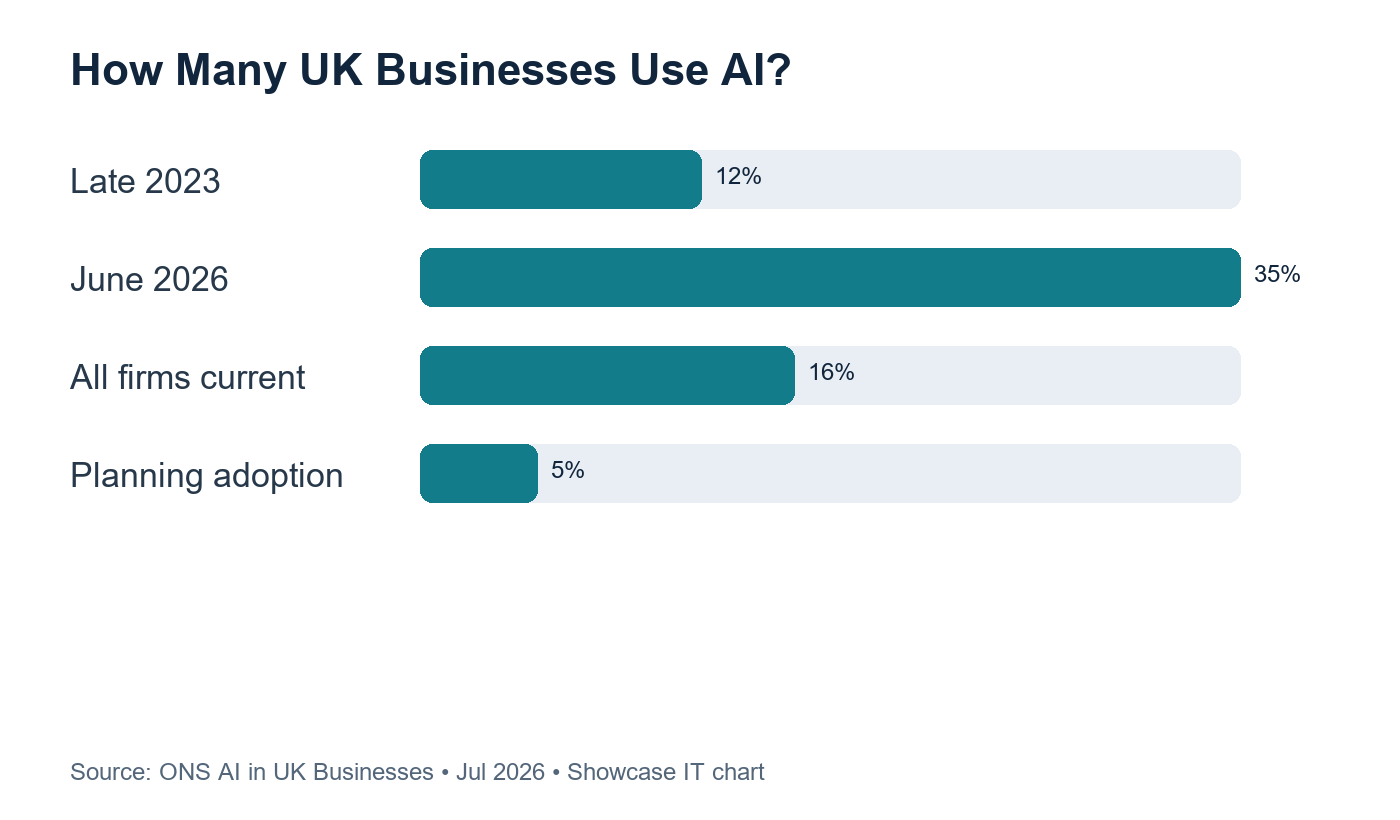
Adoption has almost tripled on the consistent larger-business measure since late 2023, while all-business research reports a lower level because micro firms are included.
!Selected UK business AI-adoption measures Figure 1: AI adoption has risen sharply, while all-business estimates remain lower. Source: ONS AI in UK Businesses, Jul 2026. Chart by Showcase IT using the source’s published statistics.
How quickly is adoption rising?
- About 35% of businesses with 10 or more employees used AI in June 2026 (ONS AI in UK Businesses, Jul 2026).
- On the published survey base, the comparable late-2023 level was about 12% (ONS AI in UK Businesses, Jul 2026).
- The official evidence also shows that the increase was about 23 percentage points (ONS AI in UK Businesses, Jul 2026).
- For planning purposes, about 35% of businesses with 10 or more employees used AI in June 2026 (ONS AI in UK Businesses, Jul 2026).
- The latest benchmark confirms that the comparable late-2023 level was about 12% (ONS AI in UK Businesses, Jul 2026).
- Sixteen percent of all surveyed businesses currently used AI (DSIT AI Adoption Research, Feb 2026).
- On the published survey base, five percent planned to adopt AI (DSIT AI Adoption Research, Feb 2026).
- The official evidence also shows that eighty percent neither used nor planned to use AI (DSIT AI Adoption Research, Feb 2026).
Why do surveys produce different rates?
- For planning purposes, sixteen percent of all surveyed businesses currently used AI (DSIT AI Adoption Research, Feb 2026).
- The latest benchmark confirms that five percent planned to adopt AI (DSIT AI Adoption Research, Feb 2026).
- The AI sector contained more than 5,800 companies (AI Sector Study 2024, Sep 2025).
- On the published survey base, sector revenue reached £23.9 billion (AI Sector Study 2024, Sep 2025).
- The official evidence also shows that sector GVA reached £11.8 billion (AI Sector Study 2024, Sep 2025).
- For planning purposes, the AI sector contained more than 5,800 companies (AI Sector Study 2024, Sep 2025).
- The latest benchmark confirms that sector revenue reached £23.9 billion (AI Sector Study 2024, Sep 2025).
Which Businesses Adopt AI Fastest?
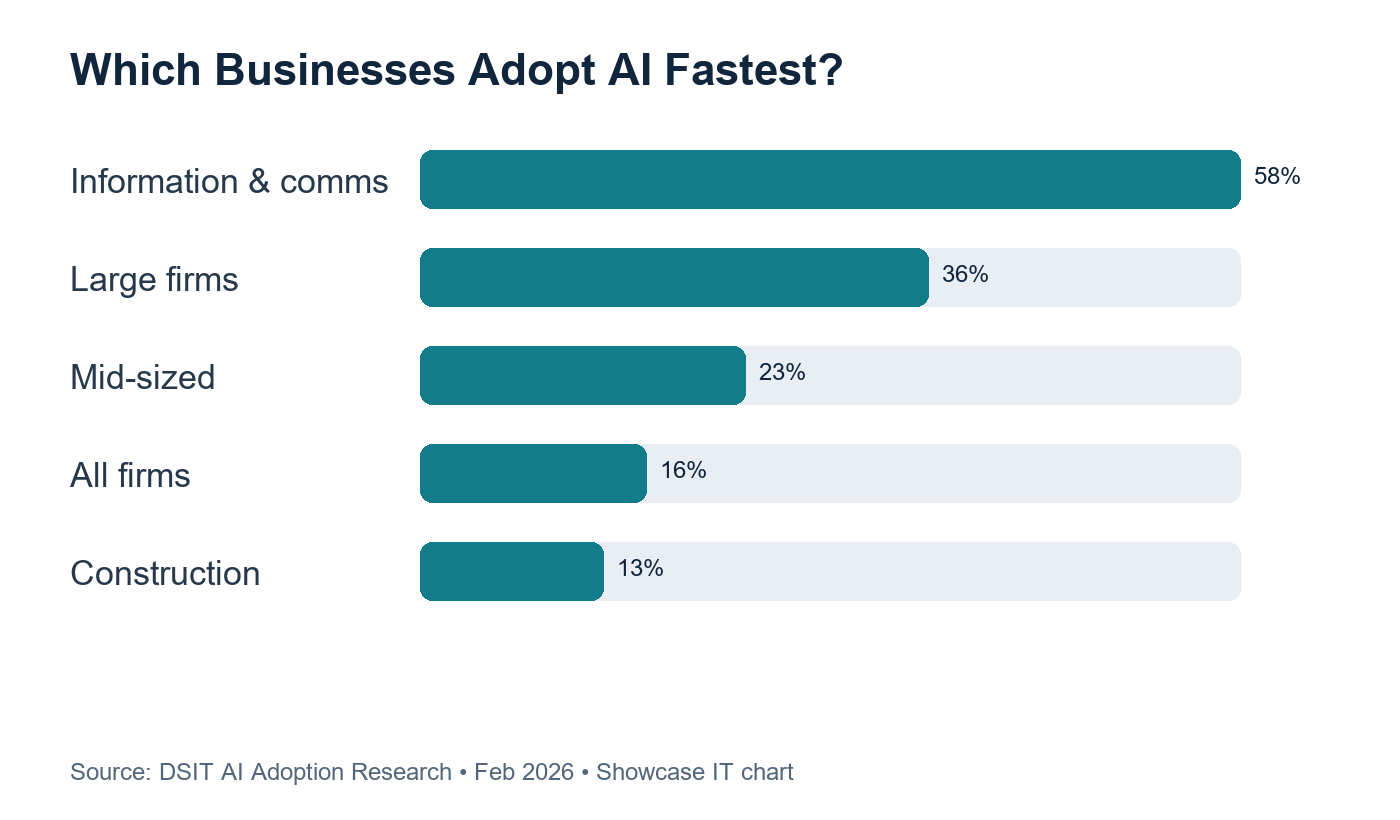
Information and communication businesses lead, construction lags, and adoption rises steeply with company size.
!AI adoption by industry and business size Figure 2: Industry and size produce large differences in reported AI adoption. Source: DSIT AI Adoption Research, Feb 2026. Chart by Showcase IT using the source’s published statistics.
How does adoption vary by industry?
- Information and communication adoption reached 58% (ONS AI in UK Businesses, Jul 2026).
- On the published survey base, construction adoption was 13% (ONS AI in UK Businesses, Jul 2026).
- The official evidence also shows that the industry gap was 45 percentage points (ONS AI in UK Businesses, Jul 2026).
- For planning purposes, information and communication adoption reached 58% (ONS AI in UK Businesses, Jul 2026).
- The latest benchmark confirms that construction adoption was 13% (ONS AI in UK Businesses, Jul 2026).
- Large-business adoption was 36% (DSIT AI Adoption Research, Feb 2026).
- On the published survey base, mid-sized-business adoption was 23% (DSIT AI Adoption Research, Feb 2026).
- The official evidence also shows that micro-business adoption was 14% (DSIT AI Adoption Research, Feb 2026).
How large is the company-size gap?
- For planning purposes, large-business adoption was 36% (DSIT AI Adoption Research, Feb 2026).
- The latest benchmark confirms that mid-sized-business adoption was 23% (DSIT AI Adoption Research, Feb 2026).
- More than 5,800 companies operated in the specialist AI sector (AI Sector Study 2024, Sep 2025).
- On the published survey base, sector revenue reached £23.9 billion (AI Sector Study 2024, Sep 2025).
- The official evidence also shows that aI-sector GVA reached £11.8 billion (AI Sector Study 2024, Sep 2025).
- For planning purposes, more than 5,800 companies operated in the specialist AI sector (AI Sector Study 2024, Sep 2025).
- The latest benchmark confirms that sector revenue reached £23.9 billion (AI Sector Study 2024, Sep 2025).
Which AI Technologies and Use Cases Lead?
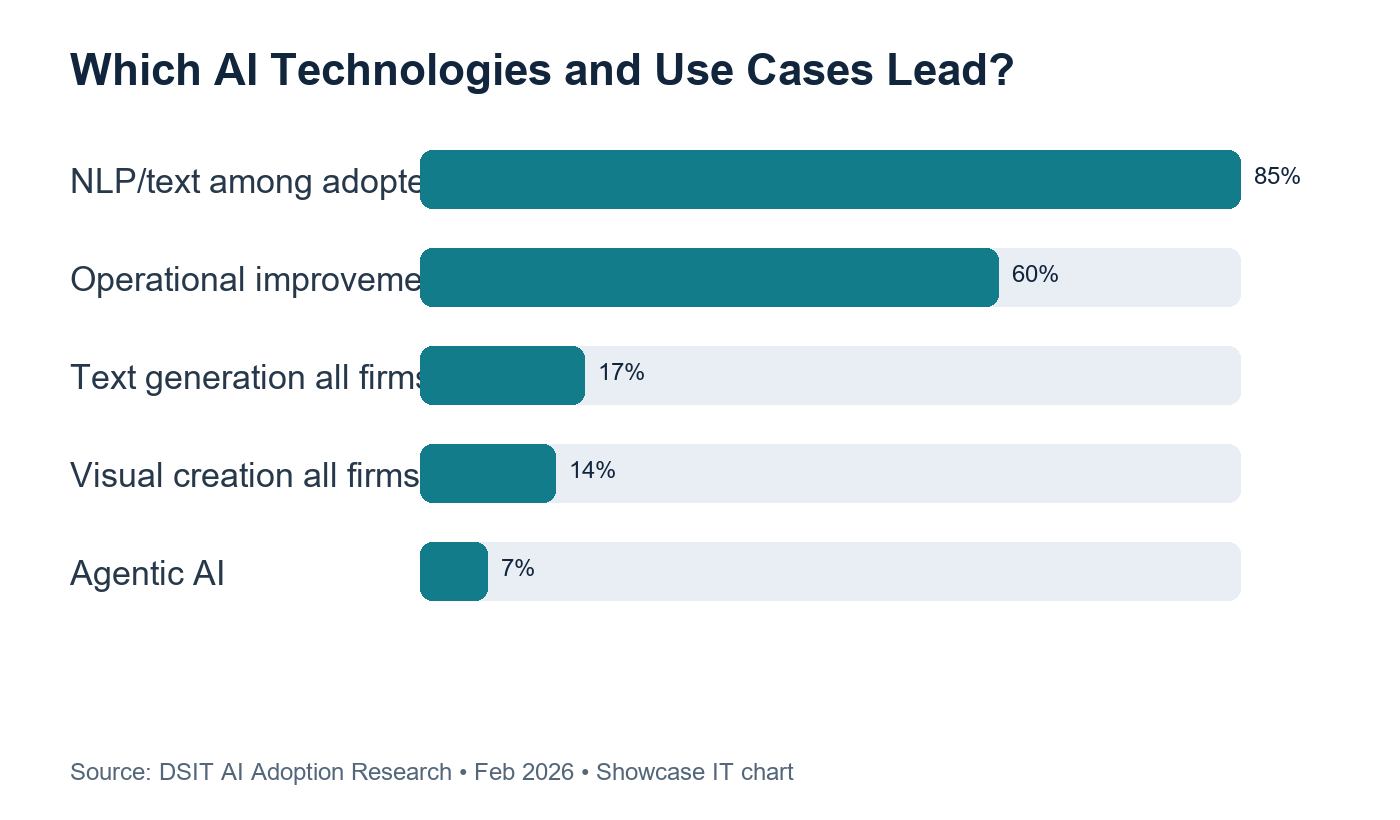
Text and language tools dominate. Most adopters focus on operational improvement and personalisation rather than entirely new products or markets.
!Leading AI technologies and uses Figure 3: Text generation is the dominant technology, while agentic AI remains uncommon. Source: DSIT AI Adoption Research, Feb 2026. Chart by Showcase IT using the source’s published statistics.
What types of AI are businesses using?
- Text generation was used by 17% of businesses (ONS AI in UK Businesses, Jul 2026).
- On the published survey base, visual-content generation was used by 14% (ONS AI in UK Businesses, Jul 2026).
- The official evidence also shows that close to 60% of adopters used AI to improve operations (ONS AI in UK Businesses, Jul 2026).
- For planning purposes, text generation was used by 17% of businesses (ONS AI in UK Businesses, Jul 2026).
- The latest benchmark confirms that visual-content generation was used by 14% (ONS AI in UK Businesses, Jul 2026).
- NLP or text generation was used by 85% of adopters (DSIT AI Adoption Research, Feb 2026).
- On the published survey base, agentic AI was used by 7% of adopters (DSIT AI Adoption Research, Feb 2026).
- The official evidence also shows that text-based systems were much more common than agentic systems (DSIT AI Adoption Research, Feb 2026).
What business purposes does AI serve?
- For planning purposes, nLP or text generation was used by 85% of adopters (DSIT AI Adoption Research, Feb 2026).
- The latest benchmark confirms that agentic AI was used by 7% of adopters (DSIT AI Adoption Research, Feb 2026).
- AI-sector revenue was £23.9 billion (AI Sector Study 2024, Sep 2025).
- On the published survey base, aI-sector GVA was £11.8 billion (AI Sector Study 2024, Sep 2025).
- The official evidence also shows that the specialist sector contained more than 5,800 companies (AI Sector Study 2024, Sep 2025).
- For planning purposes, aI-sector revenue was £23.9 billion (AI Sector Study 2024, Sep 2025).
- The latest benchmark confirms that aI-sector GVA was £11.8 billion (AI Sector Study 2024, Sep 2025).
How Deeply Is AI Embedded?
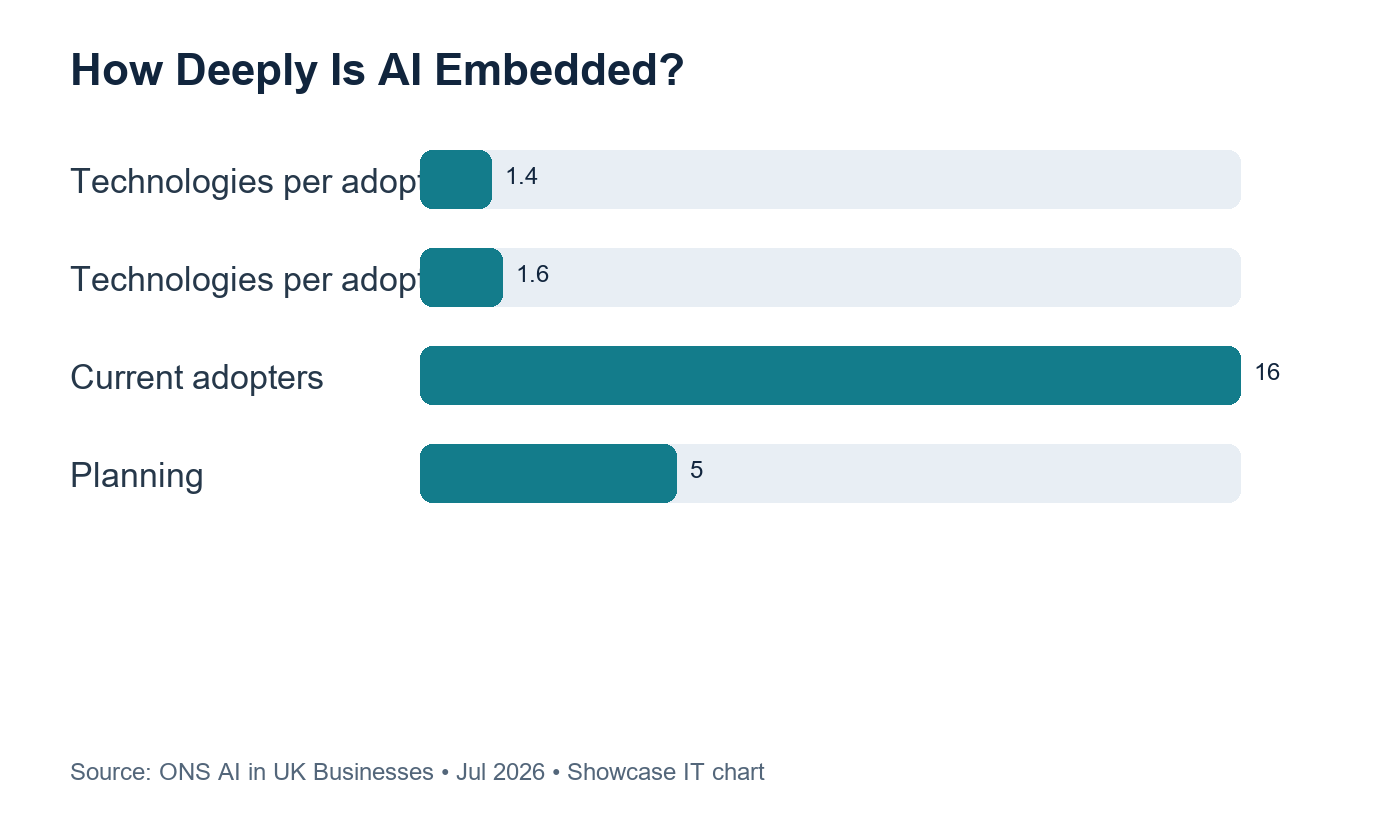
Breadth has increased only modestly. Many firms use one principal AI technology and acquire ready-to-use tools rather than building complex systems in-house.
!Depth and pipeline of business AI adoption Figure 4: The average adopter uses only slightly more AI technologies than in 2023. Source: ONS AI in UK Businesses, Jul 2026. Chart by Showcase IT using the source’s published statistics.
How many technologies does each adopter use?
- Average technologies per adopter rose from about 1.4 to 1.6 (ONS AI in UK Businesses, Jul 2026).
- On the published survey base, the increase in breadth was about 0.2 technologies (ONS AI in UK Businesses, Jul 2026).
- The official evidence also shows that acquisition methods vary significantly by industry (ONS AI in UK Businesses, Jul 2026).
- For planning purposes, average technologies per adopter rose from about 1.4 to 1.6 (ONS AI in UK Businesses, Jul 2026).
- The latest benchmark confirms that the increase in breadth was about 0.2 technologies (ONS AI in UK Businesses, Jul 2026).
- Sixteen percent of firms were current adopters (DSIT AI Adoption Research, Feb 2026).
- On the published survey base, five percent were planning adoption (DSIT AI Adoption Research, Feb 2026).
- The official evidence also shows that eighty-five percent of adopters used NLP or text generation (DSIT AI Adoption Research, Feb 2026).
How do firms acquire AI?
- For planning purposes, sixteen percent of firms were current adopters (DSIT AI Adoption Research, Feb 2026).
- The latest benchmark confirms that five percent were planning adoption (DSIT AI Adoption Research, Feb 2026).
- The AI sector included more than 5,800 companies (AI Sector Study 2024, Sep 2025).
- On the published survey base, sector revenue was £23.9 billion (AI Sector Study 2024, Sep 2025).
- The official evidence also shows that sector GVA represented nearly half of revenue (AI Sector Study 2024, Sep 2025).
- For planning purposes, the AI sector included more than 5,800 companies (AI Sector Study 2024, Sep 2025).
- The latest benchmark confirms that sector revenue was £23.9 billion (AI Sector Study 2024, Sep 2025).
How Is AI Affecting Jobs?
Employee use is higher than employer-reported adoption. Most operational AI users report no headcount change, suggesting task redesign is currently more common than immediate workforce reduction.
!Employee use and reported headcount effects Figure 5: Employee use exceeds business adoption, while most users report no headcount change. Source: ONS AI in UK Businesses, Jul 2026. Chart by Showcase IT using the source’s published statistics.
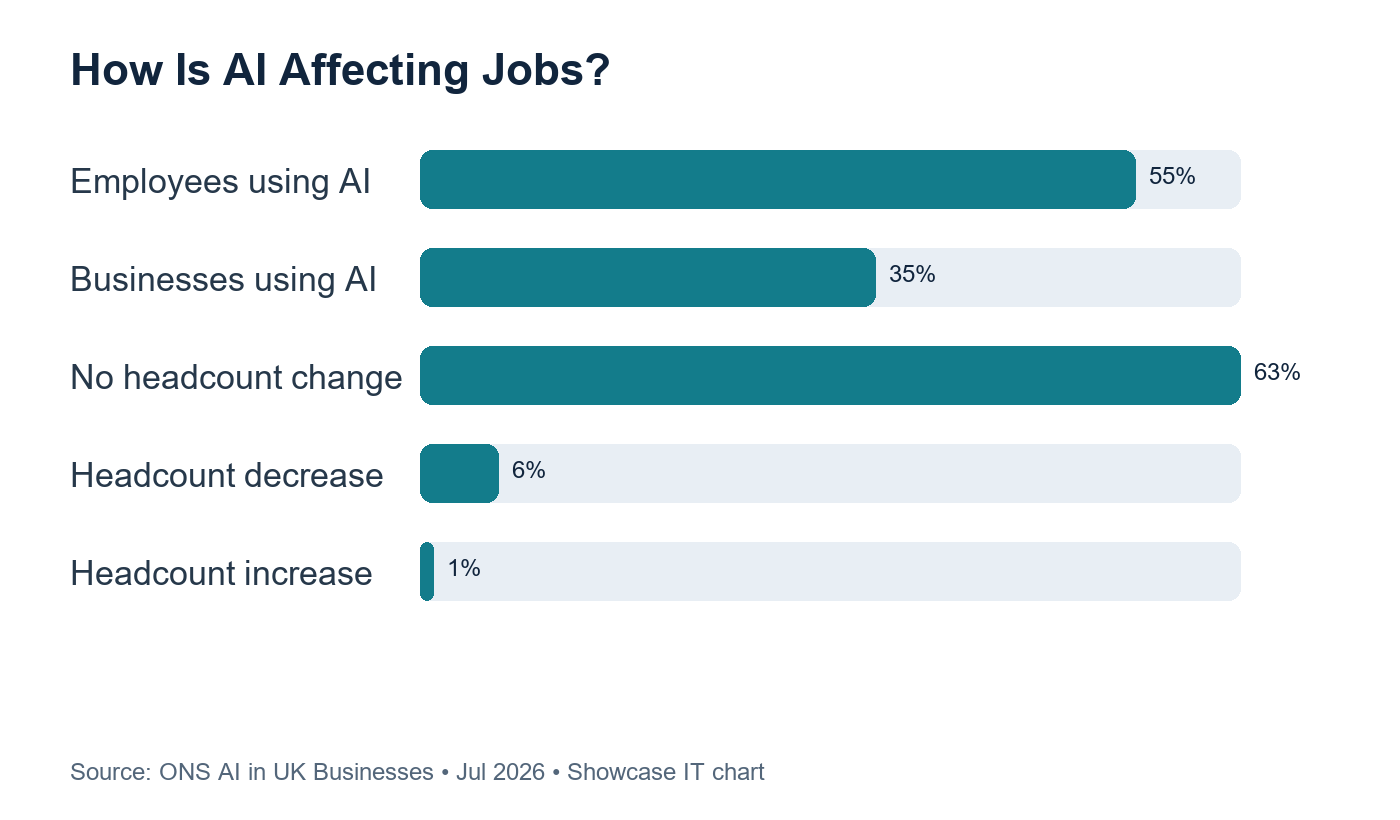
Are employees using AI more than businesses report?
- Fifty-five percent of surveyed employees reported using AI (ONS AI in UK Businesses, Jul 2026).
- On the published survey base, about 35% of larger businesses reported adoption (ONS AI in UK Businesses, Jul 2026).
- The official evidence also shows that sixty-three percent of operational users reported no headcount change (ONS AI in UK Businesses, Jul 2026).
- For planning purposes, fifty-five percent of surveyed employees reported using AI (ONS AI in UK Businesses, Jul 2026).
- The latest benchmark confirms that about 35% of larger businesses reported adoption (ONS AI in UK Businesses, Jul 2026).
- Current all-business adoption was 16% (DSIT AI Adoption Research, Feb 2026).
- On the published survey base, large-business adoption was 36% (DSIT AI Adoption Research, Feb 2026).
- The official evidence also shows that micro-business adoption was 14% (DSIT AI Adoption Research, Feb 2026).
Is AI reducing headcount or changing tasks?
- For planning purposes, current all-business adoption was 16% (DSIT AI Adoption Research, Feb 2026).
- The latest benchmark confirms that large-business adoption was 36% (DSIT AI Adoption Research, Feb 2026).
- The AI sector generated £11.8 billion in GVA (AI Sector Study 2024, Sep 2025).
- On the published survey base, aI-sector revenue reached £23.9 billion (AI Sector Study 2024, Sep 2025).
- The official evidence also shows that the sector contained more than 5,800 companies (AI Sector Study 2024, Sep 2025).
- For planning purposes, the AI sector generated £11.8 billion in GVA (AI Sector Study 2024, Sep 2025).
- The latest benchmark confirms that aI-sector revenue reached £23.9 billion (AI Sector Study 2024, Sep 2025).
What Prevents Adoption?
Expertise, cost and uncertainty about use cases constrain adoption. Training is growing, but broad workforce coverage remains limited.
!Selected barriers and training responses Figure 6: Many firms report no barrier, yet training coverage remains shallow. Source: ONS AI in UK Businesses, Jul 2026. Chart by Showcase IT using the source’s published statistics.
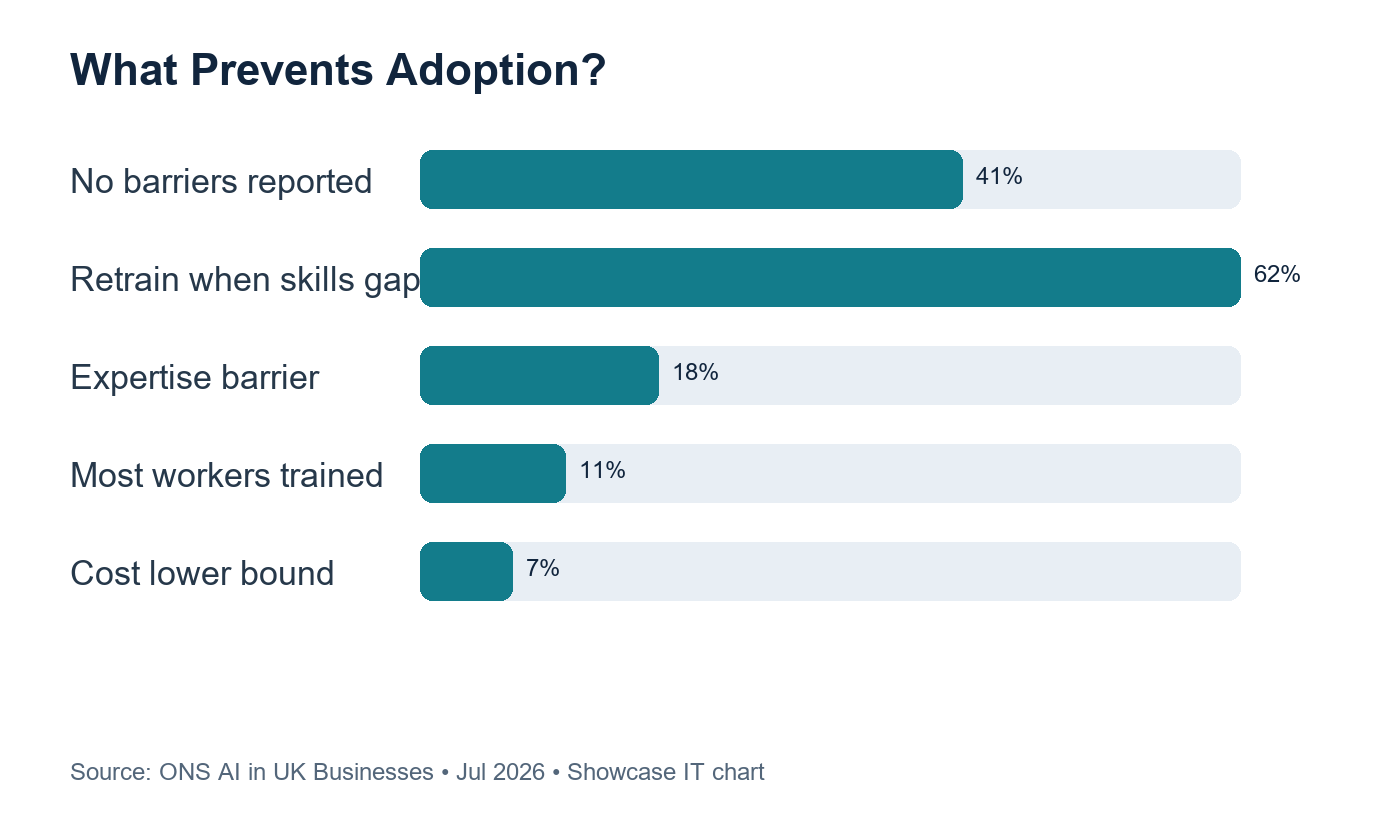
Which barriers matter most?
- Forty-one percent of larger businesses reported no AI-adoption barriers (ONS AI in UK Businesses, Jul 2026).
- On the published survey base, insufficient expertise affected 18% of firms with 100 to 249 employees (ONS AI in UK Businesses, Jul 2026).
- The official evidence also shows that only 11% said most workers had AI training (ONS AI in UK Businesses, Jul 2026).
- For planning purposes, forty-one percent of larger businesses reported no AI-adoption barriers (ONS AI in UK Businesses, Jul 2026).
- The latest benchmark confirms that insufficient expertise affected 18% of firms with 100 to 249 employees (ONS AI in UK Businesses, Jul 2026).
- Eighty percent of all firms neither used nor planned AI (DSIT AI Adoption Research, Feb 2026).
- On the published survey base, five percent were planning adoption (DSIT AI Adoption Research, Feb 2026).
- The official evidence also shows that micro-business adoption was 14% (DSIT AI Adoption Research, Feb 2026).
How are companies building AI skills?
- For planning purposes, eighty percent of all firms neither used nor planned AI (DSIT AI Adoption Research, Feb 2026).
- The latest benchmark confirms that five percent were planning adoption (DSIT AI Adoption Research, Feb 2026).
- Fifty-three percent of AI suppliers said equity access significantly affected goals (AI Sector Study 2024, Sep 2025).
- On the published survey base, thirty-six percent cited other external finance (AI Sector Study 2024, Sep 2025).
- The official evidence also shows that finance and skills constrain supplier growth (AI Sector Study 2024, Sep 2025).
- For planning purposes, fifty-three percent of AI suppliers said equity access significantly affected goals (AI Sector Study 2024, Sep 2025).
- The latest benchmark confirms that thirty-six percent cited other external finance (AI Sector Study 2024, Sep 2025).
How Large Is the UK AI Sector?
The specialist producer sector is a different population from businesses that merely use AI. It has thousands of firms and substantial revenue, but finance remains a material constraint.
!Scale and financing of the UK AI sector Figure 7: The specialist AI sector is economically substantial, while access to finance limits many suppliers. Source: AI Sector Study 2024, Sep 2025. Chart by Showcase IT using the source’s published statistics.
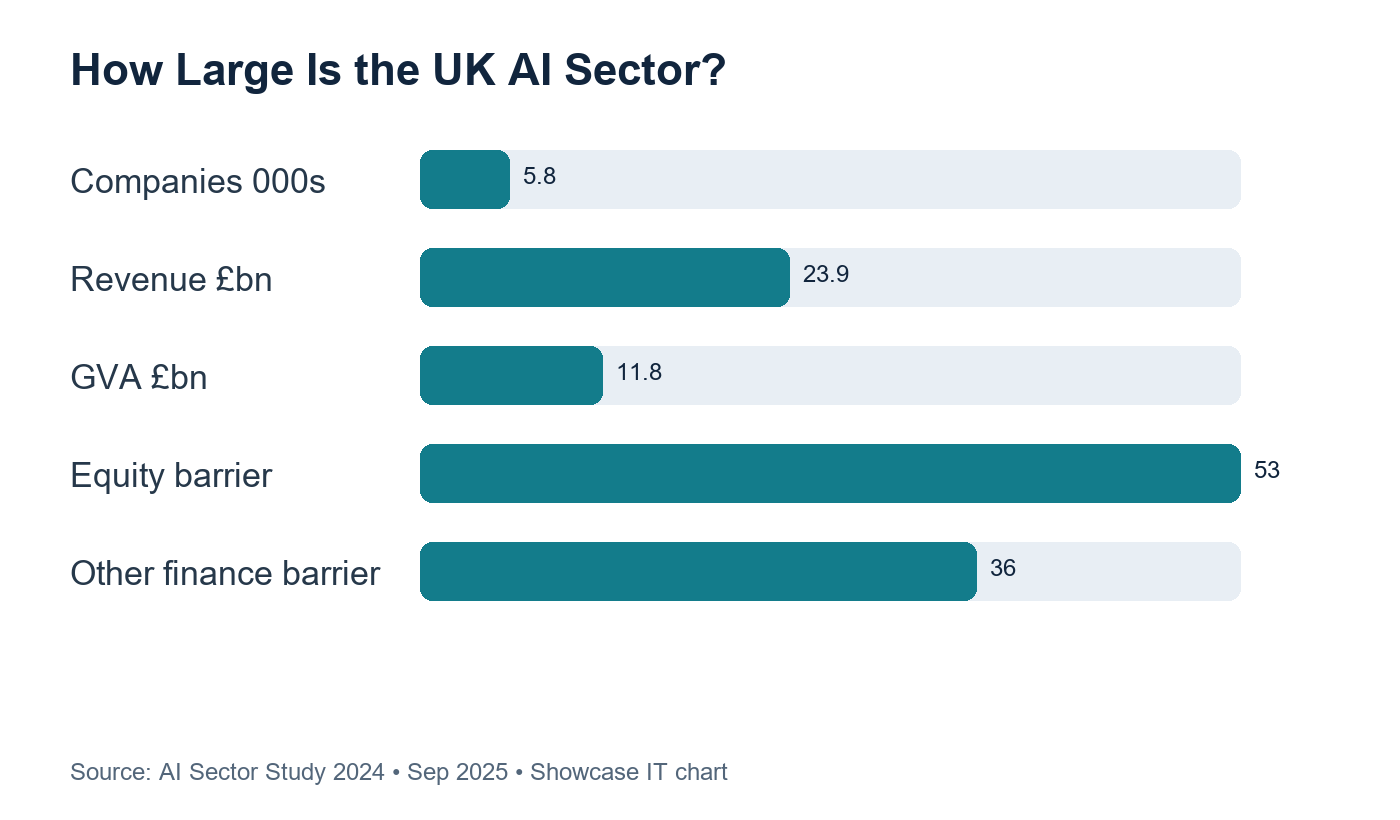
How many firms and how much revenue?
- The specialist AI sector contained more than 5,800 companies (AI Sector Study 2024, Sep 2025).
- On the published survey base, sector revenue reached £23.9 billion (AI Sector Study 2024, Sep 2025).
- The official evidence also shows that sector GVA reached £11.8 billion (AI Sector Study 2024, Sep 2025).
- For planning purposes, the specialist AI sector contained more than 5,800 companies (AI Sector Study 2024, Sep 2025).
- The latest benchmark confirms that sector revenue reached £23.9 billion (AI Sector Study 2024, Sep 2025).
- AI adoption among larger businesses reached about 35% (ONS AI in UK Businesses, Jul 2026).
- On the published survey base, employee AI use reached 55% (ONS AI in UK Businesses, Jul 2026).
- The official evidence also shows that most operational users reported no headcount change (ONS AI in UK Businesses, Jul 2026).
What limits AI suppliers’ growth?
- For planning purposes, aI adoption among larger businesses reached about 35% (ONS AI in UK Businesses, Jul 2026).
- The latest benchmark confirms that employee AI use reached 55% (ONS AI in UK Businesses, Jul 2026).
- All-business AI adoption was 16% (DSIT AI Adoption Research, Feb 2026).
- On the published survey base, large-business adoption was 36% (DSIT AI Adoption Research, Feb 2026).
- The official evidence also shows that natural-language or text systems were used by 85% of adopters (DSIT AI Adoption Research, Feb 2026).
- For planning purposes, all-business AI adoption was 16% (DSIT AI Adoption Research, Feb 2026).
- The latest benchmark confirms that large-business adoption was 36% (DSIT AI Adoption Research, Feb 2026).
Methodology and Sources
This article combines the ONS business adoption series, DSIT all-business research and the official AI Sector Study. Survey populations and definitions differ, so percentages are labelled rather than blended. Economy-wide users are kept separate from specialist AI suppliers. Figures are redrawn from the cited official values and rechecked monthly.
Glossary
- Agentic AI: AI designed to plan or carry out multi-step tasks with limited supervision.
- BICS: Business Insights and Conditions Survey.
- Generative AI: AI that creates text, images, audio, video or code.
- GVA: Gross value added.
- LLM: Large language model.
- Machine learning: Systems that learn patterns from data.
- NLP: Natural language processing.
Sources
- ONS AI in UK Businesses, Jul 2026.
- DSIT AI Adoption Research, Feb 2026.
- AI Sector Study 2024, Sep 2025.